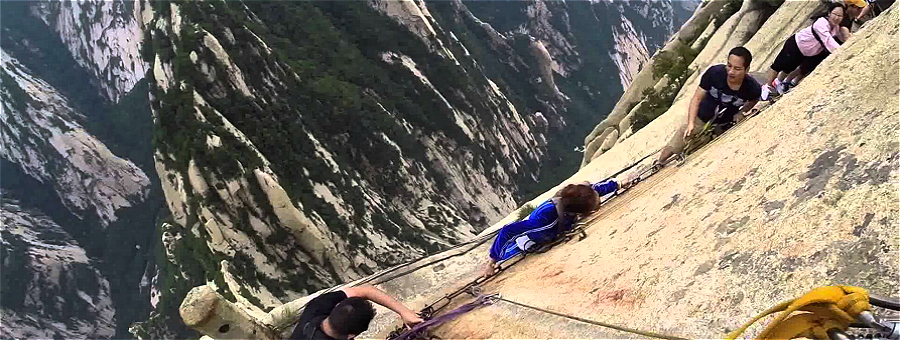
Mountain Huashan, also called Mt.Hua, is located about 120 kilometers away from ancient city Xi’an. It is known as one of the most famous mountains in China, and the most precipitous mountain on the global, famed for the narrow paths, precipitous crags and breathtaking mountain scenery. The ancient Proverb “From time immemorial the Mt. Huashan has been only one way to climb atop” testify this.
The Changkong plank Road on the South Peak of Mt.Hua is said to be the most dangerous place on the mountain range. It is Cliffside plank path built along the side of a vertical cliff. Below is the bottomless gulf which makes travelers shake with fear. So somebody who had walked on this road said it was more frightening than skydiving and bungee jumping.
Don't miss it during your Xian travel if you are mountain lovers seeking for skywalks.
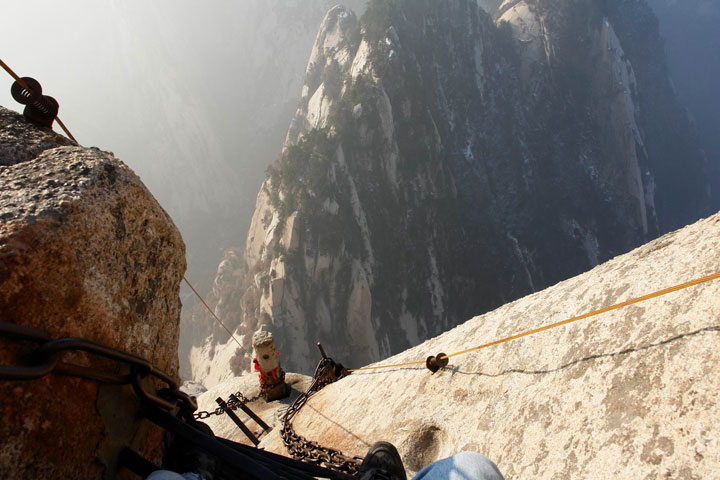
(The starting point of a sky walk on Mountain Hua, below is the iron ladder; see the scenery around or at the bottom)
Mount Huashan Changkong Plank Road Facts
- In Chinese: 华山长空栈道
- Location: On the slopes of Mount Hua's South Peak in Huayin City, Weinan City, Shaanxi Province
- Altitude: 2160.5 meters / 7088.25 feet
- Length: 110 meters / 361 feet
- Opening hours: Opening hours for the Mount Huashan Changkong Plank Trail are subject to frequent changes due to weather conditions. Please check the daily opening status for specific operating hours.
- Fee: Free; CNY 30 for safety harness rental
History - Why Was Changkong Plank Road Built
Legend has it that the Huashan Changkong Plank Road was built by He Zhizhen, the first master of the Huashan School of Chinese Taoism in the early Yuan Dynasty, in order to achieve seclusion and achieve immortality. He constructed it by embedding stone nails and assembling wooden rafters into the sheer cliffs.
Later, renowned scholars such as Chen Tuan and Taoist masters cultivated their practices on Huashan, making the Changkong Plank Road a must-go for pilgrims. Therefore, the Mount Huashan hiking trail of Changkong Plank Road is not only a marvel of engineering but also a source of Taoist legends. Legend also states that the craftsmen who built the plank road required extraordinary courage and skill, and they also had to fast, bathe, and pray for divine protection before even venturing up the mountain.
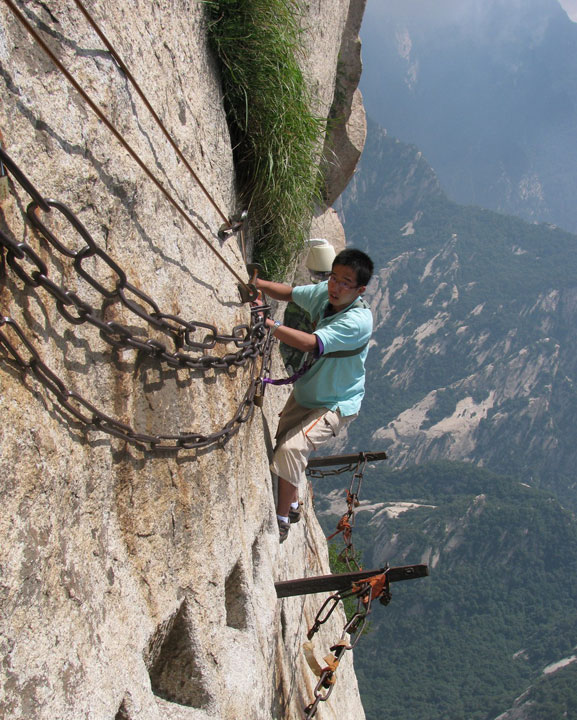
(See the footholds carved on the mountain; a man is on its journey)
Why Is It So Called
The Changkong Plank Road is located on a steep cliff and seems to be hanging in the air, hence the name "Changkong Plank Road"
How Was Mt. Huashan Changkong Plank Road Built
The earliest written records date back to the Yuan Dynasty, over seven hundred years ago. Without modern drills, harnesses, or safety ropes, how did ancient craftsmen accomplish this feat? Using only primitive tools and a precise understanding of rock and wood, they completed what seemed an “impossible task.”
First, craftsmen would secure themselves with ropes, carry their tools, and climb like mountain goats to designated points on the cliff face. On sheer precipices, they used iron hammers and chisels to meticulously carve deep holes. These holes were distributed along the outer edge of the rock face, spaced several dozen centimeters apart. Each hole had to be deep enough to securely embed thick wooden piles.
Next, solid wooden stakes, such as treated pine or cypress, are inserted into the holes. These stakes become the "main beams" of the suspended plank road. To make the stakes stronger, the craftsmen choose natural rock cracks or protrusions to ensure that the force is dispersed and the structure is stable.
On top of the wooden piles, thick planks are laid and secured with iron nails or mortise-and-tenon joints. The entire Changkong plank road on Huashan Mountain is constructed layer by layer using the principle of “embedding-pressing-connecting.”
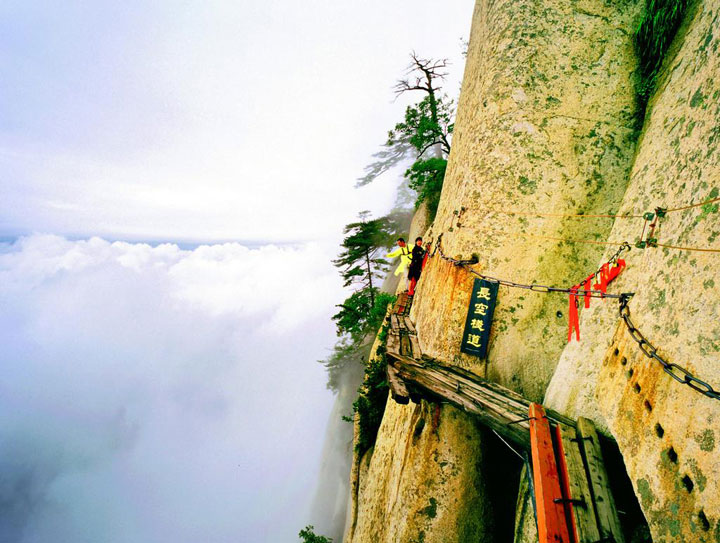
(The wooden plank road, the harness can attach on the chain along the road for safty use; see the seas of clouds under your foot)
Maintenance of the Skywalk
For wooden walkways perpetually exposed to wind and rain at high altitudes, the greatest challenge stems from natural erosion. Even corrosion-resistant cypress and pine struggle to withstand decades or centuries of sun and wind. Consequently, the planks and posts require regular replacement and repair—a tradition that continues to this day.
Maintenance workers suspend themselves from ropes outside the cliff face, working in extreme danger to remove decayed planks, replace them with new materials, and reinforce chains and guardrails. At times, severe damage to Changkong Plank Trail may necessitate temporary closure of sections of the walkway, which can only reopen after repairs meet strict standards.
How Does It Look like
The Huashan Changkong Plank Road is built clinging to the cliff face, stretching 110 meters in length at an altitude of 2,160.5 meters. To reach the plank road, first proceed to South Peak. Ascend the steps on its eastern side, pass through South Heavenly Gate, and continue to the end where you'll find the “Swallow Carrying a Clock” site (also known as “Swallow Bearing a Clock”). To its right stands a stone archway, with the characters “Halt at the Cliff's Edge” carved into the adjacent rock face. Passing through this archway leads directly to the Changkong Plank Trail.
The entire walkway is divided into three sections. The upper section, stretching approximately 20 meters from the South Heavenly Gate archway to the Chaoyuan Cave, is carved along the perilous cliff face. At the Chaoyuan Cave, the path turns and descends straight down, forming a suspended ladder section—the middle part. After exiting the suspended ladder, the path turns westward to the lower section. The first section of the Changkong Plank Road is a narrow path carved into the cliff face, approximately 20 meters long and just over two feet wide—barely enough for one person. Here, the path beneath your feet and the rock-carved walkway are secured with iron chains, making it relatively safe.
The second section features a steeply descending stone path, with a bottomless abyss stretching out before you. The second section is more perilous, especially with visitors passing in opposite directions. Climbers must attach their safety harness hooks to the safety rope on the right. Descending another 10 meters leads to the third section of the Long Sky Plank Road. Here, the plank road is flanked by sheer cliffs on both sides. One section consists of wooden planks, while the other is supported by stone or iron pillars below.
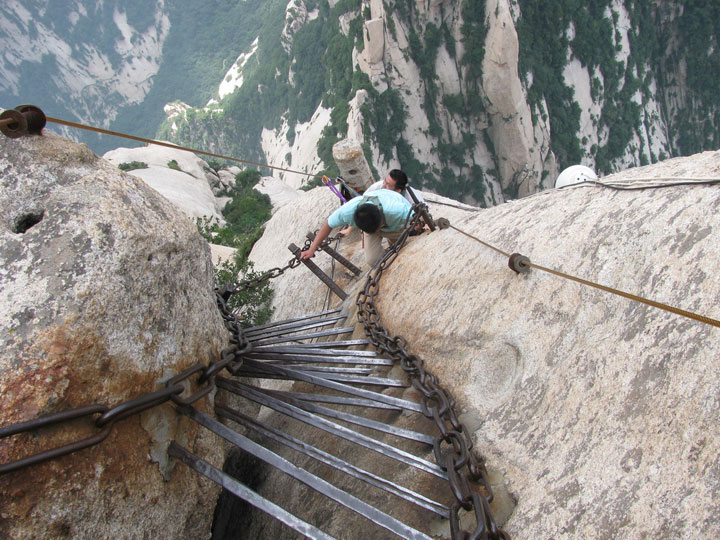
(Ascending the iron ladder, the last part of the journey)
Main Attractions to See
- Dachaoyuan Cave: After traveling the first section of the Changkong Plank Road, you'll reach Dachaoyuan Cave. The cave entrance faces south, is 40 feet deep and 30 feet high, and features a finely carved, rounded arch. Due to its small size and simple construction, it's considered a "half" cave among Mount Huashan's 72 half-caves.
- Siguo Cliff: After traveling two sections of the Changkong Plank Road, you'll reach Siguo Cliff, the end of the Changkong Plank Road. This cliff was made famous by Jin Yong's novel "The Smiling, Proud Wanderer."
- Quanzhen Cliff: Located west of Nantianmen, at the end of the Changkong Plank Road, Quanzhen Cliff is a cliff extending southward from the summit of Songhui Peak.
- Helao Stone Chamber: Located on the Siguo Cliff platform, this is a type of cave-like stone chamber and holds a vital position in Taoist culture.
Challenge the Huashan Changkong Plank Road - One of the World's Ten Most Terrifying Cliff Paths
"There's a bottomless abyss beneath your feet, wooden planks are 30 centimeters wide, and iron chains have been polished to a shine." No one who has visited Mount Huashan would dare underestimate the Changkong Plank Road. Statistics show that over 300,000 tourists visit this skywalk annually, but one-third of them turn away at the entrance.
Before starting the walk, travelers can rent out a harness (for security purpose, and travelers can attach the harness to the chain along the plank road). Come to the vertical “ladder” then go down for around 20 meters, which is consisted of some iron bolts that drilled into a narrow chute on the peak.
Finished the stone steps, then come to the wooden planks which actually called Changkong Zhdnao, with English name aptly being “floating in Air Road”. It is around 20 meters in length and 0.3 (1 feet) in width. The half-rotten planks lay on some iron bolts that were drilled into the mountain every several meters and were held together by a few rusty nails. Most travelers hold on the iron chains along tightly and face the mountain instead of looking around for grand scenery.
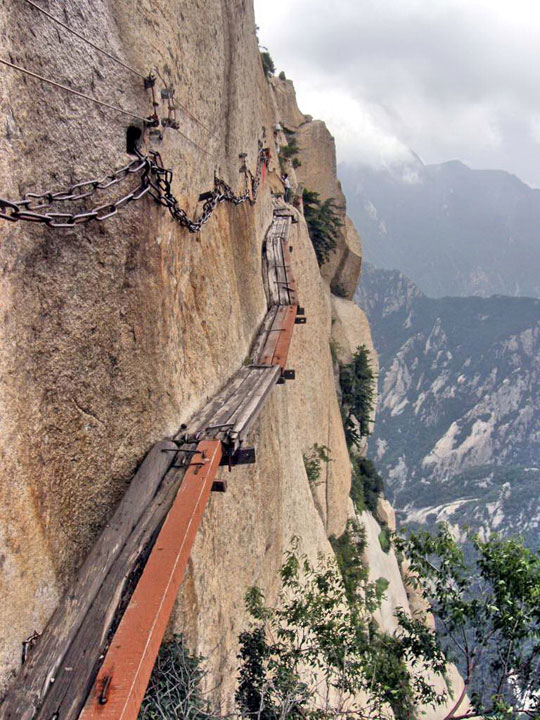
(The narrow wooden path)
The plank eventually lead to a small cliff and a shrine where hero can have a little rest and check how much they are still shaking :0.
The same challenge comes when traveler need to finish the journey, take the original way back, the plank road first, then footholds, then ascending the iron ladder at the last. Avoid those travelers who are on their way of descending!
But anyway, the plank road of Mountain Huashan is not highly recommended for travelers. From point of Easy Tour China, we would highly recommend other hiking routes in Huashan instead of walking the plank road.
Recommended China Xian Tours with Huashan Changkong Plank Road
Whether you are intrepid travelers looking for thrilling skywalks in China, or active families planning a trip to Xian with Mt. Huashan visit, Easy Tour China experts can create your own journey.