Chinese Lunar Calendar Guide 2026: Everything You Should Know
What Is the Chinese Calendar?
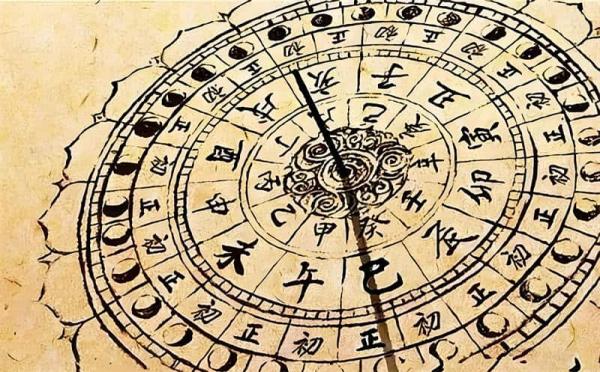
Calendars around the world generally fall into three types: solar calendars, lunar calendars, and lunisolar calendars. The Chinese calendar belongs to the third category—it’s a clever hybrid that tracks both the sun and the moon.Today’s official Chinese calendar is calculated by the Purple Mountain Observatory under the Chinese Academy of Sciences. In 2017, China even issued a national standard to formalize how the calendar is calculated—proof that this ancient system is still very much alive.Core Rules of the Modern Chinese Calendar
A Brief History of the Chinese Calendar
Believe it or not, the Chinese lunar calendar started as a survival tool. Way back in prehistoric times, people were already tracking the stars to guide farming. By the Xia Dynasty, they had the first written version, the Xia Xiao Zheng.Fast forward to 104 BCE, and the system got a massive upgrade. Emperor Wu of the Han Dynasty commissioned scholars like Sima Qian to create the Taichu Calendar, which finally standardized things like leap months and the 24 solar terms. Later on, a Yuan Dynasty astronomer named Guo Shoujing refined the calculations even more, pushing the Chinese calendar’s accuracy to a point that’s honestly mind-blowing for that era.Chinese Calendar vs. Gregorian Calendar: The Key Differences
Think of the Gregorian calendar as a reliable clock: it tracks the sun’s orbit, keeping January 1st fixed forever. The Chinese calendar works differently. It’s actually a 'lunisolar' mix. It defines months by the moon, but it uses solar terms to anchor everything to the actual seasons. This is exactly why Chinese festivals seem to 'jump around' on your phone's calendar—they are following a rhythm that combines both the moon and the sun.Understanding Days, Months, and Years in the Chinese Calendar
Days in the Chinese Calendar
Each lunar month in the Chinese calendar begins on the new moon. The first day is called Chu Yi (初一), and the last day is Hui (晦). The full moon—Wang (望)—usually falls around the 15th day.
Days of the Chinese lunar calendar are counted sequentially. The first ten days all start with the prefix Chu (like Chu Yi for the 1st). Days 11 to 20 switch to standard numbering. The 20s, however, get a bit special—they use a unique character called Nian (廿) as a shorthand for 'twenty.' So, the 21st is simply Nian Yi. If there’s a 30th day, it’s simply called San Shi.
Months in the Chinese Calendar
Months in the Chinese calendar follow the moon’s phases. One full cycle—from new moon to new moon—lasts about 29.53 days. That’s why lunar months alternate between 29-day short months and 30-day long months.
In the Chinese lunar calendar, not every month is simply numbered. A few carry unique historical weight. The first month, for instance, is Zheng Yue (正月)—a term with roots in ancient scripts. Then there’s the 11th month, called Dong Yue (Winter Month), leading into the famous La Yue. As the 12th and final month, La Yue is synonymous with the rush of preparations just before the Spring Festival.
Leap Month
The Chinese calendar adds a leap month to stay in sync with the seasons, not just to fix math on paper. Without it, festivals would slowly drift away from spring or autumn, and farming schedules would fall apart. The word leap here really means “extra,” not a bonus month you celebrate separately.
A leap month—formally known as an intercalary month in the Chinese lunar calendar—appears when a lunar month contains no major solar term. Instead of creating a brand-new month name, the calendar simply repeats the previous month—so you might hear things like “leap April.” These leap months don’t follow a fixed cycle, which is why people still check the Chinese calendar carefully every year.
Years in the Chinese Calendar
Because of the leap month system in the Chinese lunar calendar, the length of a Chinese lunar year varies significantly. While a standard 12-month year has about 353–355 days, a leap year with 13 months can last up to 383–385 days. The famous “19-year, 7-leap-month” cycle ensures that over almost two decades, the lunar and solar calendars align within a single hour—a mind-blowing achievement for ancient astronomy.
How the Chinese Calendar Is Used Today
Traditional Chinese Festivals
China’s major festivals all follow the Chinese calendar, not the Gregorian one. Chinese New Year falls on the first day of the first lunar month and usually lands between late January and mid-February—check the Chinese New Year 2025/2026 calendar if you’re planning ahead. Dragon Boat Festival comes on the 5th day of the 5th lunar month, while Mid-Autumn Festival is always on the 15th day of the 8th lunar month.Heavenly Stems and Earthly Branches
This is one of the most confusing parts of the Chinese calendar. Think of it as an ancient coding system for time. It doesn’t just label years; it reflects balance, rhythm, and how the universe is believed to move.
There are Ten Heavenly Stems and Twelve Earthly Branches. When paired together—always yin with yin, yang with yang—they form a 60-year cycle known as the Ganzhi system. This cycle is still used today to name years, calculate birth charts, and power the Chinese astrology calendar and horoscope.
| Category | 1 | 2 | 3 | 4 | 5 | 6 | 7 | 8 | 9 | 10 | 11 | 12 |
| Heavenly Stems | Jia (甲) | Yi (乙) | Bing (丙) | Ding (丁) | Wu (戊) | Ji (己) | Geng (庚) | Xin (辛) | Ren (壬) | Gui (癸) | — | — |
| Earthly Branches | Zi (子) | Chou (丑) | Yin (寅) | Mao (卯) | Chen (辰) | Si (巳) | Wu (午) | Wei (未) | Shen (申) | You (酉) | Xu (戌) | Hai (亥) |
Chinese Zodiac (Chinese Calendar Signs)
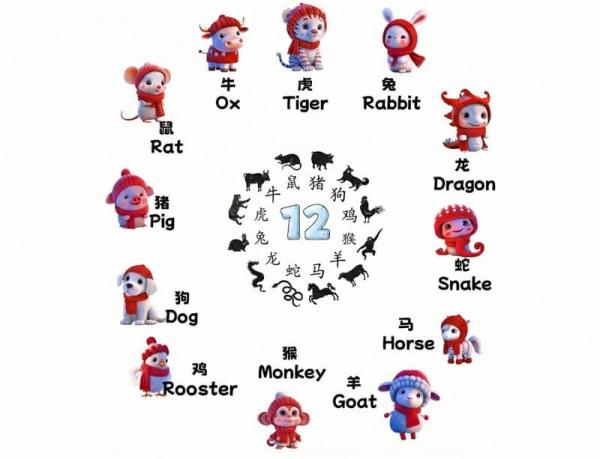
The Chinese zodiac is probably the most traveler-friendly part of the Chinese lunar calendar—and the one locals love to talk about the most. Each lunar year is linked to one of the twelve Chinese calendar animals, and people genuinely believe these signs shape personality, luck, and even compatibility. These animals correspond directly to the 12 Earthly Branches.
It’s not just about the birth year, though—in China, a huge part of the population still celebrates Chinese calendar birthdays instead of the Gregorian dates. Below is a table of the calendar for the Chinese zodiac that allows you to easily discover your animal sign based on your birth year.
| Zodiac Animal | Birth Years |
| Rat | 1936, 1948, 1960, 1972, 1984, 1996, 2008, 2020 |
| Ox | 1937, 1949, 1961, 1973, 1985, 1997, 2009, 2021 |
| Tiger | 1938, 1950, 1962, 1974, 1986, 1998, 2010, 2022 |
| Rabbit | 1939, 1951, 1963, 1975, 1987, 1999, 2011, 2023 |
| Dragon | 1940, 1952, 1964, 1976, 1988, 2000, 2012, 2024 |
| Snake | 1941, 1953, 1965, 1977, 1989, 2001, 2013, 2025 |
| Horse | 1942, 1954, 1966, 1978, 1990, 2002, 2014, 2026 |
| Goat | 1943, 1955, 1967, 1979, 1991, 2003, 2015, 2027 |
| Monkey | 1944, 1956, 1968, 1980, 1992, 2004, 2016, 2028 |
| Rooster | 1945, 1957, 1969, 1981, 1993, 2005, 2017, 2029 |
| Dog | 1946, 1958, 1970, 1982, 1994, 2006, 2018, 2030 |
| Pig | 1935, 1947, 1959, 1971, 1983, 1995, 2007, 2019 |
The 24 Solar Terms
Forget just marking time—the 24 solar terms in the Chinese calendar paint a picture of the seasons. Finalized way back in the Han Dynasty, this system breaks the year into micro-seasons that describe subtle changes in the weather with incredible accuracy. It might sound ancient, but it’s still very much alive. Whether it's knowing when to eat dumplings or when to prepare for the cold, these solar markers quietly dictate the flow of life and travel in China.
The Chinese Almanac (Huangli)
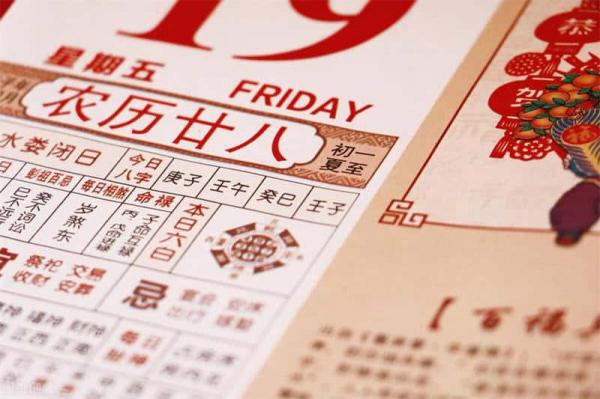
The Chinese Almanac, or Huangli, is a very down-to-earth side of the Chinese lunar calendar. Based on yin and yang and the five elements—wood, fire, earth, metal, and water—it marks certain days as good or bad for things like travel, construction, or big life decisions. It may sound superstitious at first, but many rules come from long-term observation of nature and seasonal change.
It doesn't stop at wedding dates, though. There’s also the widely shared Chinese gender calendar, a chart that uses the mother's lunar age to guess a baby's gender.
Chinese Calendar 2025 & 2026
If you want to take a China cultural tour around festivals, cultural events, or specific zodiac celebrations, the Chinese calendar is worth a quick look before you book anything. It’s not just about finding out what year and day it is in the Chinese calendar; the lunar dates decide when the festivals happen, which days cities slow down, and when temples and old towns feel especially lively.
2025: Year of the Snake (Yi Si Year / 乙巳年)
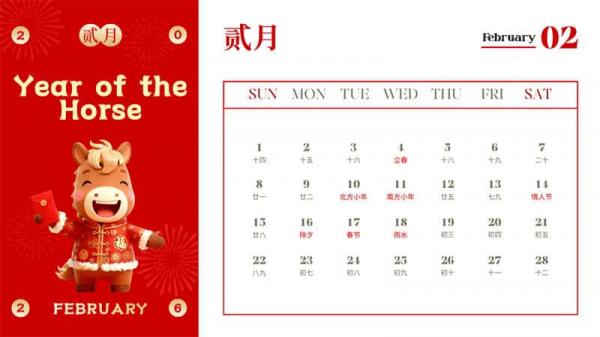
2026: Year of the Horse (Bing Wu Year / 丙午年)
Plan a China Tour with Easy Tour China
The Chinese Calendar is just one way into Chinese culture—but seeing it on the road is something else entirely. Traveling with people who actually live here makes all the difference. If you’re curious to experience China beyond the usual highlights, travel with Easy Tour China, a tour expert specializing in tailor-made China tours for over 20 years. Let us customize a China trip just for you, or take a look at our best China tours.