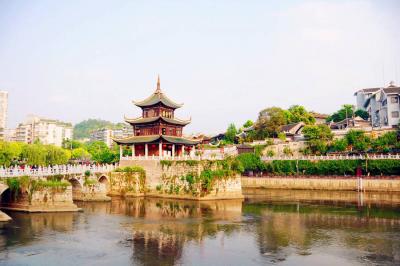
Huangguoshu waterfall
Guizhou Huangguoshu waterfall is one of the biggest waterfalls in China and one of famous waterfalls in the world. It is 74 meters in height and 81 meters in width, forming majestic vigor and grand sight. There exist different sights in day and evening or four seasons. When it comes to summer and autumn, the Huangguoshu waterfall is world-shaking and heart-quake; when it comes to spring and winter the water fall is graceful and coquettish. It is like an argent dragon in the brilliant sunshine.
Located in a Zhenning town 45 kilometer from Anshun city, Huangguoshu scenic spot gives priority to waterfall, cave and underground lake. The waterfall is surrounded with overlapped chain of mountain and verdant forests. A hundred-meter cave traverses behind the Huangguoshu Waterfall and the white water-curtain is just hanging the outside therefore the cave is also called water-curtain cave. When you get out of the cave and permeate the waterfall you will feel the power and vigor of the nature.
Moreover, Huangguoshu is home to Buyi and Miao and special stone-buildings stand everywhere. There are lots of spots of interest and historical sites nearby, especially the Hongyan stele (red rock stele), making the area a must-visit place if you plan a trip to Guizhou.
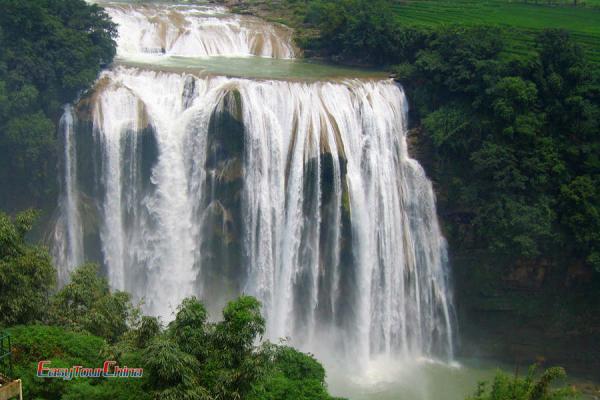
Huangguoshu Waterfall Facts
How Was the Huangguoshu Waterfall Formed
Over 200 million years ago, the Huangguoshu Waterfall developed within a sequence of “Medium-thick layers of calcareous sandstone interbedded with thin layers of calcareous siltstone from the Guanning Stage II of the Middle Triassic.”During the formation period of the Huangguoshu Waterfall, the Baishui River was an overland river that evolved between 100,000 and 500,000 years ago, During the Himalayan Orogeny, repeated intermittent crustal uplifts lowered the river's erosion base level, intensifying its incision through erosion and dissolution. This created a “fracture point” where fissures, caves, and underground rivers became highly developed.
The Baishui River initially formed a karstic erosion-type plunge-hole waterfall. Over time, driven by river erosion, dissolution, lateral erosion, intermittent crustal uplift, and the warming, humid climate of the late Pleistocene, the hydrodynamic forces gradually intensified. The roof of the plunge-hole cavern progressively collapsed, ultimately giving rise to the Huangguoshu Waterfall, which has stood for 50,000 years.
Huangguoshu Waterfall Weather and Best Time to Visit
The location where the Huangguoshu Great Waterfall is situated belongs to the mid-subtropical zone. It is a typical area of soluble rocks, with a mild climate and abundant rainfall. The annual rainfall is over 1300 millimeters, with most of the rain concentrated in May to July, averaging above 200 millimeters monthly. And the rainfall June is nearly 300 millimeters. December is the month with the least rainfall throughout the year, with an average monthly rainfall of less than 20 millimeters.
Huangguoshu Waterfall is located in a low-lying area of western Guizhou Province. At a relatively low altitude, it is frost-free year-round with an average annual temperature of around 14℃. Winters are mild, and summers are not scorching, making it one of the best places to visit in China in summer and winter to escape the cold and heat. January is the coldest month, with an average temperature of 4.3℃, but the minimum temperature rarely drops below zero. July is the hottest month, with an average temperature of 22℃, and there are virtually no days with extreme heat.
Considering temperature, rainfall, rate of flow, and the waterfall's peak visual appeal, June through October offers the optimal time to visit Huangguoshu Waterfall.
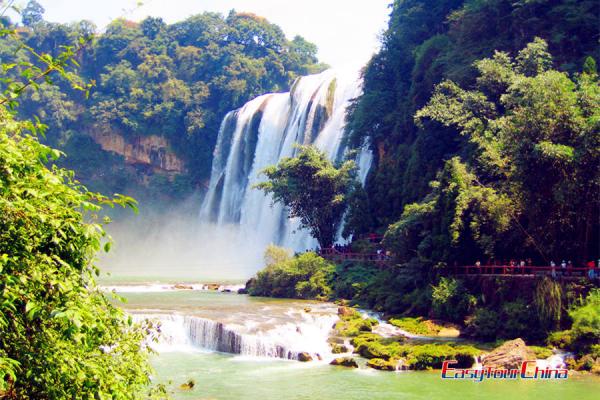
What to See in Huangguoshu Waterfall Group
The Huangguoshu Waterfall Group comprises the Huangguoshu Grand Waterfall and 18 other waterfalls of varying shapes and sizes, including Dishuitan, Doupotang, Luositan, and Yinlianzhuitan. Covering an area of 163 square kilometers with an average elevation of 900 meters, the group is recognized by the Guinness World Records as the world's largest waterfall group.
Its surrounding karst caves and cavernous landscapes integrate seamlessly with the waterfalls to form a complete natural scenic complex.
Huangguoshu Waterfall
Huangguoshu Waterfall lies on the Baishui River section of the Dabang River basin. Flowing southward from the north, the river encounters a major longitudinal slope fracture at Huangguoshu, forming the main cascade. After plunging over the falls, the water turns westward in a near-semicircular arc spanning 500 meters in chord length and projecting 300 meters westward. It then reaches the Screw Beach below Shuiguachong, resuming its north-to-south course.
The waterfall spans 101 meters in width and plunges 77.8 meters in height. The cascading waters plunge into Rhino Pool, then sequentially flow through Three Rapids, Horseshoe Rapids, Pig Dragon Pool, Oil Fish Well, Pot Bottom Pond, Bay Pond, and Bubbling Pond.
The water flow of the falls varies from a few cubic meters per second during low flow to over 1,000 cubic meters per second at peak. During high flow, spray from the falls reaches over 100 meters up to Huangguoshu Street, with thunderous roars audible two or three kilometers away. Even during low flow, the river divides into four branches, spreading across the entire rock face.Huangguoshu Falls is the world's only waterfall viewable from six directions: above, below, front, back, left, and right. It is also the world's sole waterfall featuring a naturally formed Water Curtain Cave (134 meters) where visitors can hear, see, and touch the water from within the cave.
>> Related reading: 10 most beautiful waterfalls in China
Dishuitan Waterfall
Located 8 kilometers west of Huangguoshu Waterfall, Dishuitan boasts the greatest total height among the Huangguoshu cascade group. Here, two mountains stand facing each other: Dapo Peak to the east and Guansuo Ridge to the west. Between them lies the 700-meter-deep Balin River Gorge, with the waterfall cascading down the face of Guansuo Ridge. Dishuitan Falls reaches a total height of 410 meters—six times that of Huangguoshu Falls—with its lowest tier plunging 134 meters in a majestic cascade.Chongkeng Waterfall
Located 700 meters upstream of Dishuitan Waterfall within a faulted gorge, it has a total height of 160 meters.Liantian Waterfall
Situated 500 meters upstream of Chongkeng Waterfall, it features a multi-tiered cascade 26 meters high and over 10 meters wide. Its surging waves reach the sky, hence the literal translation “Sky-Reaching Waterfall.”Guanjiao Gorge Waterfall
Also known as Nada Guan Waterfall, it comprises three tiers with a total drop of 140 meters and a width of 50 meters. The gorge plunges over 700 meters deep. It boasts the largest water flow among the Huangguoshu waterfalls.Green Beauty Pool Waterfall
Descending from the Great Tree Rock, the Fanhua River forms the Green Beauty Pool Waterfall, standing 50 meters tall and over 10 meters wide.Spider Rock Waterfall
Traveling four kilometers west from Huangguoshu to the Fanhua River valley reveals Spider Rock Waterfall, where a waterfall surges from a cave in a cliff face. At a height of 30 meters, an 8-meter-diameter opening in the cliff spews forth a torrent like a dragon spewing water.Steep Slope Pond Waterfall
Located one kilometer upstream from Huangguoshu Falls, the Doupotang Falls stand 21 meters tall and span 105 meters wide, making them the widest waterfall in the Huangguoshu cascade. The entire cascade forms upon a calcified terrace. More remarkably, it emits a deep roar before flood peaks arrive, earning it the nickname “Roaring Falls.”Natural Bridge Waterfall
Situated 300 meters southwest of Shitou Village on the Baishui River, it is a limestone calcified waterfall. Tianshengqiao Waterfall features two tiers, with a total height of 72 meters and a width of 30 meters. It derives its name from the natural limestone arch formed by a calcified cave atop the first tier.
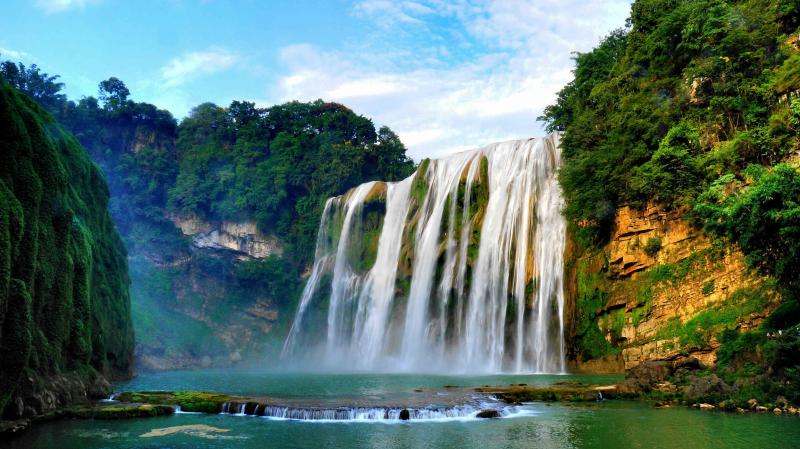
Silver Chain Dropping into the Pool Waterfall
Located in the Water Stone Forest area of Tianxingqiao Scenic Area, this waterfall resembles a chain. The waters of the Sancha River are divided by calcified terraces into cascading chains of pearls that plunge into a deep pool. It is the most exquisite waterfall among the Huangguoshu waterfall group.Luositan Waterfall
Located one kilometer downstream from the main Huangguoshu Waterfall, this cascade features a calcified terrace stretching 350 meters long and 20 meters wide. Its formation is closely linked to fault zones and calcified sedimentation.Longmen Fei Waterfall
Located within the Longgong Scenic Area upstream of Wang'er River, Longmen Fei Waterfall stands 38 meters tall and 25 meters wide. As a cave waterfall within the Huangguoshu cascade system, it is also China's largest karst cave waterfall.Recommended Guizhou Tours with Huangguoshu Waterfall
How to Get to Huangguoshu Waterfall
Huangguoshu Waterfall is located 45 kilometers from Anshun City and 150 kilometers from Guiyang, the capital of Guizhou Province.By Air
The closest airport to Huangguoshu is Anshun Huangguoshu Airport, which operates air routes from Beijing, Kunming, Dalian, Qingdao, and some other Chinese cities.
Due to limited direct flights, travelers from other cities can transfer at Guiyang Longdongbao Airport and take a direct bus from Guiyang to Huangguoshu Falls. A direct airport shuttle bus operates from Guiyang Airport to Anshun, costing 60 RMB per person with departures every two hours.
By China High-Speed Rail
The high-speed train ticket from Guiyang North to Anshun West costs approximately 50 yuan per person and takes about 30 minutes. The train ticket from Guiyang Station to Anshun Station costs approximately 15 yuan per person and takes about 1 hour.
After arriving in Anshun, you can take a direct shuttle bus to the Huangguoshu Waterfall. The ticket price is 20 yuan per person and the journey takes about 40 minutes.
Practical Travel Tips
- Recommended itinerary: Grand Waterfall → Steep Slope Pond → Tianxing Bridge
- Wear comfortable, non-slip shoes as extensive walking is required.
- Bring rain gear; entering Water Curtain Cave during high-water periods may expose you to mist.
- To avoid crowds and long queues, you are suggested to visit Huangguoshu Waterfall Scenic are during weekdays and avoid holidays—especially China Golden Week of National Day Holiday.
- Self-service luggage lockers are now available at Huangguoshu. Rates: Large locker 15 RMB/10 hours, Medium locker 10 RMB/10 hours, Small locker 5 RMB/10 hours.
- Craving authentic Guizhou cuisine? Don't miss sour soup fish, fermented rice wine spicy fish, chili chicken, stir-fried wild vegetables with pork, Anshun small rolls, and Anshun grilled pork intestines.