Yungang Grottos
With the wide spread of Buddhism in China in the second century, grotto art was introduced to China from India, developing rapidly between the second and fourth centuries. Grottoes were carved in cliff faces in various places, particular in North China. The best known Buddhist grottoes in China are Dunhuang Mogao Caves, Maijishan Grottoes in Gansu Province, the Longmen Grottoes in Henan Province and the Yungang Grottoes in Shanxi Province.
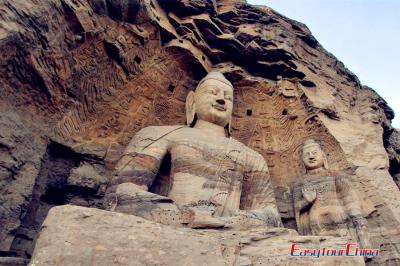
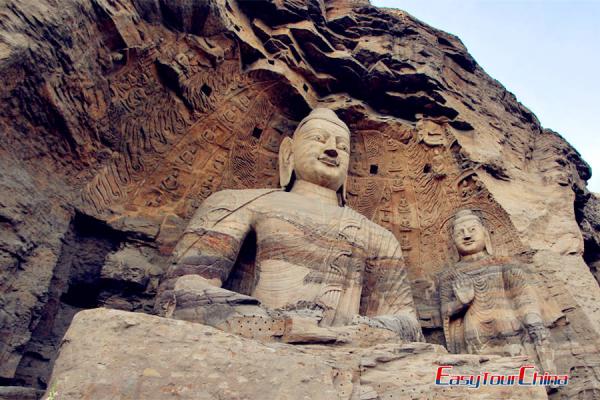
Located 16 kilometers west of Datong city, the Yungang Grottoes are hewn out of cliff-sides in a honeycomb pattern, stretching for 1,000 meters (1 km) from east to west. The Grottoes were built more than 1,500 years ago in the Northern Wei Dynasty. The huge project got underway around 460. Within four decades, a thousand grottoes and some one hundred thousand Buddhist statues were completed together with large numbers of niches and colorful decorations.
Nowadays, more than 59,000 statues remain, the largest being 17 meters high and the smallest only few centimeters. Whether huge or tiny, all are meticulously carved. The Yungang Grottoes is one of the largest group grottoes in China and also a world famous art treasure.
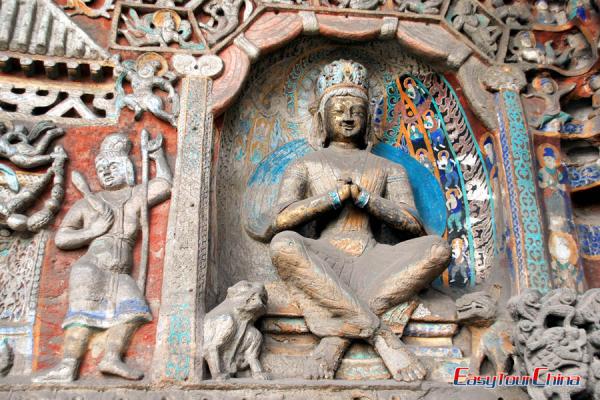
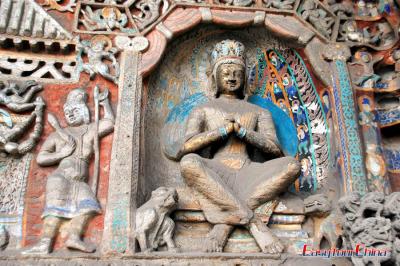
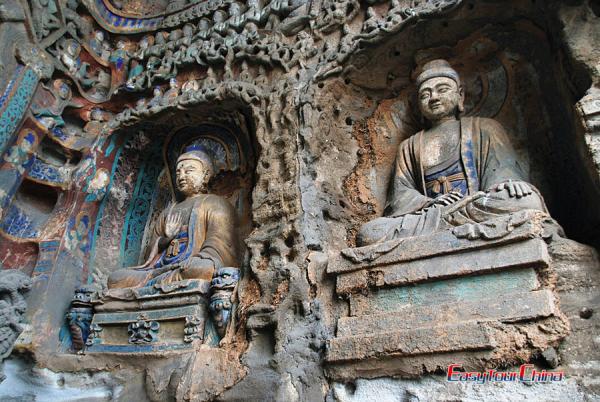
Apart from the Buddhist statues there are multiple niche on the wall of the stone chambers and these are embellished with sculpture of flying Apsaras, Buddhist episodes, edifices, flowers and other quaint design. They benefit the study of ancient Chinese architecture, sculpture, costumes, art, painting, carving and musical instruments.
In 2001, Yungang Grottoes in Datong was added to the list of World Heritage Sites by UNESCO. It is now a must-visit sight when traveling in Datong, especially if you are interested in China Buddhist tours.
Yungang Grottos Facts
Yungang Grottos History
In 460, Emperor Wencheng of the Northern Wei Dynasty, Tuoba Jun, accepted the suggestion of the eminent monk Tan Yao to “carve five caves into the mountain cliffs at the Western Zhou Pass to the west of the capital city.” This marked the beginning of the century-long construction of the Yungang Grottoes (originally called the Wuzhou Mountain Grottoes).
In the 15th year of the Zhenguan era of the Tang Dynasty (641 AD), the governor of Pingcheng (present-day Datong City) rebuilt the Great Stone Temple.
During the Liao Dynasty, the imperial court undertook a decade-long, large-scale restoration of the Wuzhou Mountain cave temples. Ten major temples—Tongle, Lingyan, Jingchong, Zhongguo, Huguo, Tiangong, Chongfu, Tongzi, Huayan, and Tushetu—were constructed to connect with the wooden cave eaves at the front. Over a thousand Buddhist statues were also restored. However, in 1122, Jin Dynasty forces captured Datong, and the monastery was burned and looted. Subsequently, from the third to sixth years of the Huangtong era (1143-1146), the abbot Master Binghui rebuilt the “Lingyan Grand Pavilion” (the pavilion outside Cave 3 today).
During the Jiajing era of the Ming Dynasty, the site began to be called the Yungang Grottoes. In the seventeenth year of the Chongzhen reign (1644) during the late Ming dynasty, Li Zicheng's rebel army passed through Datong, and the Yungang temples were once again ravaged by war, reduced to ashes.
In the eighth year of the Shunzhi reign (1651) of the Qing dynasty, the Yungang Temple was rebuilt. The wooden cave eaves of existing Caves 5 and 6 and the temple complex date from this reconstruction.
The Caves and Features of the Yungang Grottoes in Different Historical Periods
| Period | Cave Number | Architectural Form and Statue Features |
| During the Peaceful Years of Emperor Wencheng of Northern Wei (460 - 465 AD) | 1. Caves 16 - 20 of Yungang Grottoes (“Tanyao Five Caves”); 2. Divided into two groups based on the main statue’s content and layout: ① Caves 18, 19, 20; ② Caves 16, 17 | ① Most caves generally mimic the thatched - hut style with an elliptical plan and a domed roof; ② Statues mainly depict the Buddhas of Three Ages(Past Buddha, Present Buddha, Future Buddha) and Thousand Buddhas; ③ The main statue is large in size, occupying most of the cave’s interior. |
| During Emperor Xiaowen’s Reign of Northern Wei (approx. from post - Emperor Wencheng era to before the capital relocation to Luoyang in the 18th year of Taihe, 494 AD; 465 - 494 AD) | Divided into five groups:- Four groups of “double caves”: ① Caves 7 & 8 (earliest in Phase 2, likely completed in Xiaowen’s early reign); ② Caves 9 & 10 (slightly later than 7/8, dubbed “completed in Year 8 of Taihe and finished in Year 13”); ③ Caves 5 & 6 (late stage of Xiaowen’s rule in Pingcheng; main statues here are also the Buddhas of Three Ages); ④ Caves 1 & 2 (a pagoda - style cave group, incl. unfinished Cave 3. Originally planned as a massive pagoda cave, its interior remained incomplete through Northern Wei. In early Tang, a seated Buddha en face and attendants were carved on the southwest of the unfinished pagoda’s south face. Small niches on pre - carved cave walls cluster in Caves 11, 13, 16, 17, etc.); - One group of three caves: ⑤ Caves 11, 12, 13. Additionally, major projects inside/outside Yungang’s largest cave (Cave 3) during Northern Wei, small caves on Cave 11’s outer cliff, and scattered small caves west of Cave 20 also belong to Phase 2. | ① Plans are mostly square, often with front/rear chambers, though some mimic Phase 1’s oval thatched - hut shape; ② Some caves have pagoda pillars in their centers; ③ Others carve tunnel - like worship passages on the rear wall; ④ Square - planed caves’ wall carvings use vertical layering + horizontal segmentation; roofs often feature pingqi(lattice - like patterns); ⑤ Fewer colossal statues; modeling lacks former grandeur, yet themes diversify (secular donor processions become popular); ⑥ Raised clothing folds are replaced by simplified, stepped - section folds; ⑦ Wall layouts with hierarchical segmentation & inscriptions, plus traditional Han - style architecture/decor, grow more common from Han/Wei onward; ⑧ By Phase 2’s late stage, Buddha statues adopt new kuan yi bo dai(wide - lapel, sashed robe) styles. Foreign Buddhist grotto art in North China began notable Easternization at this time; ⑨ A practice emerged: carving small niches on pre - made cave walls, including single - image, paired - image, and multi - tiered niches. |
| Wei Xiaowen Emperor's Taihe 19 ~ Zhengguang 5 of the Northern Wei Dynasty(494 - 524 AD) | The main caves are distributed west of Cave 20 of Yungang Grottoes. Small caves (such as Caves 1, 4, and 15), small caves on the upper part of the west cliff face (from Cave 11 westward), and small - to - medium - sized caves between Caves 4 and 6 mostly belong to this period. In addition, in the first - and second - phase caves, there are also niches carved in the third phase. | ① There are no grouped caves; small and medium - sized caves are numerous, and niches with diverse layouts are scattered across the area.② The interiors of caves are increasingly square - shaped. Pagoda - caves (the unnumbered pagoda - cave and Cave 39 between Caves 4 and 5), Thousand - Buddha Caves (Caves 14 and 15), ~20 four - walled multi - nichecaves, and ~30 four - walled three - nichecaves (popular styles of this period) are representative of such caves.③ Arched facades and guardian figures (and other decorations) emerged on the cliff faces outside cave entrances, with decorations becoming more elaborate over time. The rich and vivid relief scenes common in the second phase are rarely seen now. While no new individual image types appeared, forms grew leaner, folds of lower - body clothing grew more layered, and lintels/canopy decorations grew more complex. |
Layout
Of the existing 45 caves of Yungang Grottoes, 21 are spacious and divided into three distinct groups: the eastern, middle and western. The eastern group (Grottoes 1 to 4) contains mainly pillars and Buddhist statues; the middle group (Grottoes 5 to 13) and the western group (Grottoes 14 to 21) are the most splendid.Most Famous Caves and What to See
Cave 3
Also known as the Lingyan Temple Cave, it is the largest cave in the Yungang Grottoes. The rear chamber features three large statues, with the central figure being a reclining Buddha approximately 10 meters tall. The attendant bodhisattvas on either side stand 6 meters high.
Cave 5
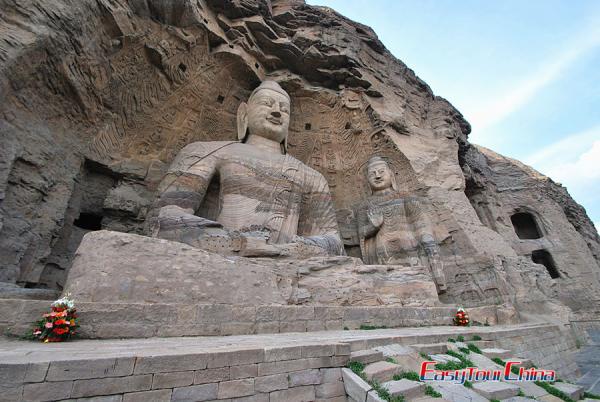
Currently the only surviving ancient cave eave structure at Yungang, it maintains relatively stable temperature and humidity inside. With a maximum east-west width of about 22 meters and a maximum north-south depth of about 17 meters, it is the largest cave of its type at Yungang. The main seated Buddha stands 17.40 meters tall, making it the largest Buddha at Yungang.
>> Related reading: 8 Giant Buddha Statues in China
Caves 7 and 8
These represent the earliest twin caves at Yungang. Cave 7 features particularly exquisite carvings of its light window and archway. An archway on the north side of Cave 8 connects it to Cave 7. The surviving carvings depicting a honeysuckle-adorned double-stemmed lotus with four buds highlight its uniqueness among the Yungang caves.Cave 11
This cave houses the earliest square stone pagoda at Yungang. Its western wall features a large roofed niche containing seven standing Buddha statues. Additionally, the upper section of the eastern wall holds an inscription stele dating to the seventh year of the Taihe era (483 CE) during the Northern Wei dynasty. This stele contains the most extensive and complete text among all Northern Wei inscriptions at Yungang Caves.
Cave 12
Named the “Music Cave” due to its numerous statues depicting musicians. Musicians are depicted from east to west playing instruments including shoulder drums, xun flutes, yizui flutes, waist drums, qin zithers, konghou harps, bìlì flutes, pipa lutes, zheng zithers, transverse flutes, pipa lutes, pan flutes, qí drums, and chui fingers. This represents an exceptionally valuable and unique surviving record in Chinese music history. A group of dancing figures also adorns the lintel.
>> Related reading: Chinese Traditional DanceCave 13
A seated Bodhisattva with crossed legs, approximately 13.6 meters tall, is supported by a four-armed attendant holding up its massive arm.
Caves 16–20
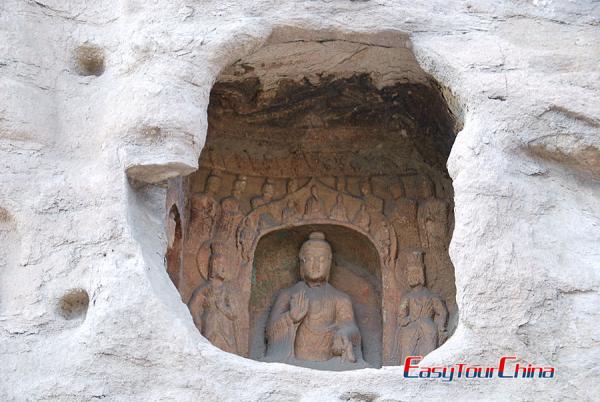
These form the renowned “Five Caves of Tan Yao.” Caves 16 and 17 constitute a single complex. The principal image in Cave 16 is a standing Shakyamuni Buddha, 13.5 meters tall, clad in a robe with wide sleeves and sashes, featuring a knotted belt hanging down the chest—a style reflecting the Han-style clothing promoted during the Taihe era of the Northern Wei dynasty. Cave 17 is the only early Yungang cave housing a large Bodhisattva statue in the crossed-leg posture.
Cave 18 features a standing Buddha statue 15.5 meters tall. Cave 19 centers on the Three-World Buddhas, with the principal figure standing 16.8 meters tall—the second-largest Buddha statue in the Yungang Grottoes. The main Buddha in Cave 20, measuring 13.7 meters in height, retains the stylistic legacy of Gandhāra sculpture. It stands as both a representative masterpiece and a symbol of the Yungang carving art, representing an unparalleled achievement in early Chinese Buddhist sculptural art.
How to Visit Yungang Caves: Suggested Traveling Route
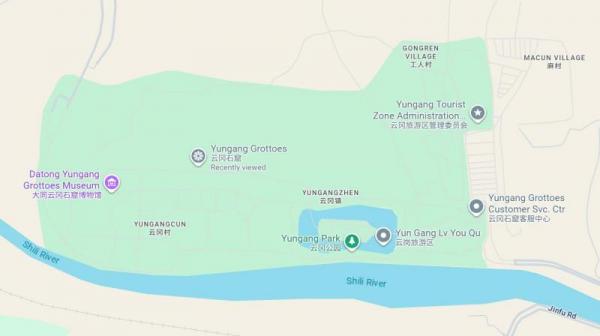
Entrance → Tanyao Square → Buddhist Worship Avenue → Lingyan Temple → East Four Caves (Caves 1 to 4) → Small Hill Unnamed Caves → Caves 5 to 15 → Tanyao Five Caves (Caves 16 to 20) → Western Grottoes (Caves 21 to 45) → Yungang Museum → Yungang Study → Buddha Shadow Hall → Mimi Main Store → Commercial Street → Exit
>> Recommended 7 Days Datong Mount Wutai Taiyuan Pingyao Tour
Best Time to Visit
The Yungang Grottoes are located in Datong, a city with a temperate continental monsoon climate. Bordered by the Inner Mongolian Plateau to the north and frequently under the influence of high pressure, while the Mount Heng and Taihang Mountains to the southeast block winds, the area is rarely affected by maritime winds. The city experiences four distinct seasons: long, cold, and dry winters, and short, warm, and rainy summers. The best time to visit the Yungang Grottoes is from September to November, when Datong’s weather is cool and pleasant, with average temperatures ranging from 10-20°C.
How to Get to Yungang Grottoes from Datong
>> Discover more Datong Travel Tips