Yunnan Stone Forest (Shilin)
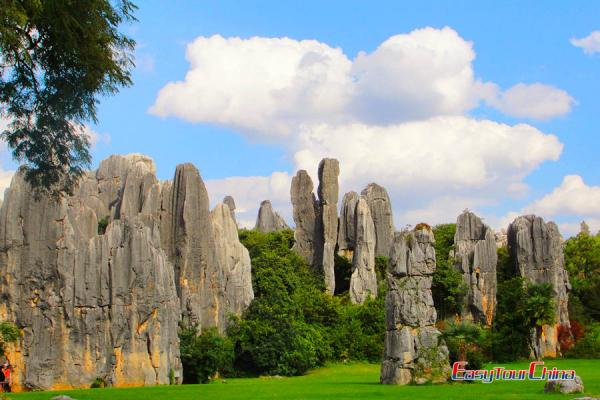
Situated 75 miles southeast of Kunming in Yunnan, China, the Stone Forest is a wonder of geology. About 200 million year ago the earth's crust shifted and forced the 200 acres of karst limestone stalagmites rise up from what was once a huge expanse of water. Paths wind through its spectacular valleys and around the weird rock formations and its reflecting pools. There are pavilions perched high on these pillars that offer sweeping views.
Within the geopark area, clusters of stone forests of all sizes are distributed across hillsides, valleys, and depressions, forming today’s Stone Forest Scenic Area and the Black Pine Rock Scenic Area (Naigu Stone Forest). Since the Ming Dynasty (1368-1644), Kunming Stone Forest has long been one of the most famous scenic spots in China.
One of the world's most famous karst landform tourist destinations, Kunming Stone Forest is known as a "natural museum of karst landforms" by international karst research experts. In 2004, it became a UNESCO Global Geopark, and in the same year, it was listed as a World Natural Heritage Site along with Chongqing Wulong Karst, Guizhou Libo Karst, and Guilin Karst. Today, it remains a highlight of Yunnan travel to Kunming.
China Stone Forest Facts
Where is the Stone Forest Located
It is situated in the eastern part of the karst plateau in the second step of China's topographic hierarchy. Its geographical coordinates are 24º38' - 24º58' north latitude and 103º11' - 103º29' east longitude.How Was the Stone Forest Formed
The formation of Kunming's Stone Forest involved a lengthy and complex geological evolution. During the Early Permian period 270 million years ago, the Stone Forest region was a marine environment where seabed sediments formed hundreds of meters of limestone.
260 million years ago, tectonic movements uplifted the area into landmasses. Compression fractured the limestone, and situated at the humid ancient coastline's edge, dissolution created the earliest stone forest formations.
250 million years ago, massive volcanic eruptions buried the early stone forest beneath volcanic rock (basalt). Throughout the Mesozoic Era and early Cenozoic Era, the region remained eroded and leveled. After nearly 200 million years of coverage, by the end of the Mesozoic Era 65 million years ago, most of the volcanic rock had been eroded away, exposing the early stone forest once again.
Approximately 60 million years ago, the Himalayan orogeny tilted and uplifted the Shilin area, transforming it into an inland intermontane lake environment—the Lunan Ancient Lake—where parts of the stone forest were again covered by lake sediments. Since the Late Tertiary, the Shilin region has continued to rise, evolving into the modern plateau river valley environment. Under sustained, phased uplift processes and varying geographical and climatic conditions, the Shilin landform has undergone inheritance, replacement, and superimposition. Older stone forests gradually disappeared while new ones continuously formed.
Over the past 20 million years, the ancient lake vanished, and the Shilin region gradually evolved into a plateau basin while developing its most recent phase of stone forests.

When and How Was the Park Built
The term "Shilin (Stone Forest)" first appeared in the poem "Heavenly Questions" by Qu Yuan (the historical figures related to the origin of the Dragon Boat Festival), a poet from over 300 BC, which asked, "Where is the Shilin?" During the late Ming and early Qing dynasties of the 17th century, a few explorers and literati visited the Stone Forest and wrote many poems and essays praising its wonders. In 1931, Long Yun, the former chairman of Yunnan Province, visited the Stone Forest and inscribed the characters "Shilin," which were later carved on stone pillars. From then on, "Stone Forest" became its official name. In the same year, the Stone Forest Scenic Area Management Office was established.Geological and Geomorphological Overview
The plateau surface in the Shilin area exhibits relatively gentle undulations, with an overall topography that slopes from east to west and from north to south. Elevations range between 1,700m and 1,950m, with only a few isolated ridges and peaks exceeding 2,200m.Thick Paleozoic carbonate rocks are widely distributed throughout the area, giving rise to abundant, unique, and diverse plateau karst landforms. Within the Stone Forest Geopark, primary landform types include plateau hills, low mountains, medium-height mountains, depressions, basins, stone hills, stone forests, stone-covered plains, peak clusters, karst caves, river valleys, lakes, and waterfalls. Among these, the stone forest landforms and their diverse combinations are the most eye-catching: richly varied and unpredictable surface dissolution features, diverse types of stone pillars, dissolution peaks, and their combinations form the park's most distinctive geological and landform heritage landscape.
>> You may also be interested in: Ten Unique National Forest Parks in China
Top Attractions
Shilin Scenic Area
Located at the heart of the entire Stone Forest Geopark, Shilin Scenic Area comprises five parts: the Greater Shilin, Lesser Shilin, Bushaoshan, Liziyuanqing, and Wannian Lingzhi. Covering a total area of 12 square kilometers, it showcases typical karst landforms, especially the sword-shaped stone forest, which is magnificent and breathtaking. Famous attractions include "Ashima," "Lotus Peak," "Sword Peak Pool," and "Rhinoceros Gazing at the Moon."
First to greet the tourists in the park is a huge natural Stone Forest wall carved with eight red Chinese characters which can be translated as "A myriad pinnacles stand erect, receding one after another into the distance". The inscription is the handwriting of Mr. Zhu De, the late Chief Commander of People's Liberation Army. A little further on is another stone wall on which are carved "Shi Lin" (Stone Forest in Chinese). Further down, strange pinnacles resembling bamboo shoots, giant pillars, pagodas, swords, lions, sleeper tigers, camels, or wild ox will surround the people on every side once they enter the "forest". The local guide will tell you many legends related to these weird-look rocks.
Furthermore, the combination of the stone forest with flowers, trees, underground rivers, and deep pools displays extraordinary natural beauty.
>> Recommended 4 days Kunming Tour with Stone Forest

Naigu Stone Forest Scenic Area
Located 8 kilometers north of the Stone Forest Scenic Area and 17 kilometers from Shilin County, this region earned the name “Black Pine Rock” due to its overall topography resembling a verdant pine forest when viewed from above.Most stones in Naigu Stone Forest take the form of castles, towers, or mushrooms. In addition to blade-like ridges and sword-shaped pillars similar to those in the Shilin Scenic Areas, there are numerous spire-topped pillars. These pillars separate at their tops but remain connected at their bases, forming stone walls, stone cities, and stone arrays.Changhu Scenic Area
Located 25 kilometers south of the Stone Forest Scenic Area in Weize Village, Changhu Town, the Changhu Scenic Area sits nestled within mountains at an altitude of 1,907 meters. The lake's shape resembles a slender maiden and is believed in folklore to be the homeland of Ashima. Key attractions include Dushishan (Solitary Stone Mountain), Dajianshan (Great Peak Mountain), Erjianshan (Second Peak Mountain), Sanjianshan (Third Peak Mountain), Mopan Mountain (Millstone Mountain), Penglai Island, and Yuanhu (Round Lake). The scenic area covers a total area of 3.94 square kilometers.Stone Forest and the Sani People
Humans have inhabited the Stone Forest region since the Stone Age. The scattered clans and tribes that lived here thousands of years ago are the ancestors of today's Yi people in the Stone Forest. Sani people is a branch of the Yi nationality. Early Yi rock paintings and carvings adorn the stone pillars of the forest, which has become deeply woven into every facet of the local Sani people's lives—their religion, legends, poetry, dance, embroidery, clothing, architecture, and festivals.
A legend about “herding stones to form a forest” has long been passed down among the Sani. The Sani hero Jin Fenruo Jia sought to dam the river for the people. He stole the “Mountain-Moving Order” and the “Mountain-Driving Whip,” and at night drove stones from southern areas like Luliang to the Nanpan River region in northern Yiliang. However, as dawn approached while passing through Shilin County, the divine power of the rooster's crow disrupted his feat. The stones came to rest in the Shilin area, forming the densely clustered stone forest we see today.
>> Learn the 56 Ethnic Groups in ChinaMost of all Sani girls excel at spinning, weaving and embroidering. And these people are born singers and dancers. Each day at sunset, boys and girls gather at the village platform. The boys usually play the three-stringed plucked instruments while the girls dance joyfully at a strongly rhythmic pace.Torch Festival
The Stone Forest Torch Festival has been passed down for over two thousand years. Every year on the 24th day of the sixth lunar month, the Yi people don festive attire and express their joy through wrestling, bullfighting, songs, and dances, celebrating the harvest and praying for peace together. This festival is hailed as the “Carnival of the East.”Mizhi Festival
Participation is exclusively male, with women absent from the festivities, earning it the distinction of being the world's only festival for men. The festival spans seven days, from the Rat Day to the Horse Day of the eleventh lunar month each year.
>> Recommended China Eco & Ethnic Tours including Yunnan Stone Forest

Weather & Best time to visit
Stone Forest Geological Park has a typical subtropical plateau wet and dry monsoon climate. The rainy season is from May to October, and the dry season is from November to April of the following year, with an average annual precipitation of 939.5 mm. The average annual temperature is 18℃, with June being the hottest month (average temperature 21.2℃) and January the coldest month (average temperature 9.3℃).
The best time to visit Stone Forest is spring (April to May) and autumn (September to November).
>> Related reading: Kunming Climate and Weather
How to get to Stone Forest in Kunming
By High-speed Rail, EMU Trains, and Regular TrainsDaily trains departing from Shanghai, Guangzhou, Nanning, Zhanjiang, Guiyang, Hongguo, Kunming, and other cities arrive at Shilin Railway Station. Bus Route 66 operates between Shilin West Station and Shilin County Town, while Bus Route 99 runs between Shilin West Station and the Stone Forest Scenic Area. >> Read more about Kunming Travel Tips
From Downtown Kunming to Stone Forest Scenic Area
Buses depart every 30 minutes from Kunming East Bus Station, with a journey time of approximately 1.5 hours. The fare is RMB 26 per person.From Kunming Changshui International Airport
Airport shuttle buses operate hourly from 09:00 to 20:00, with a journey time of approximately 1.5 hours and a fare of 60 RMB.Plan Your Yunnan Stone Forest Tour with Easy Tour China
Discover the natural wonder of Stone Forest, witness beautiful landscapes from Kunming to Dali, Lijiang and Shangri-La, learn about the China's diverse ethnic culture, and savor best local food - a private Yunnan tour crafted by ETC can suit your personal needs.