Wuzhen Water Town
Table of Contents
- 1. Brief History of Wuzhen Town
- 2. Wuzhen Attractions: What to See
- 3. Top Things to Do in Wuzhen, Zhejiang
- 4. Wuzhen Weather and Best Time to Visit
- 5. Hotels in Wuzhen Town
- 6. How to Get to Wuzhen Water Village
Wuzhen, one of China's most famous water towns of fish, rice, and silk, locates at the north of Tongxiang City of Zhejiang Province, China, and at the center of the triangle formed by Shanghai, Hangzhou and Nanjing. It covers an area of 71.19km with a total population of 60,000 and permanent residents of 12,000.
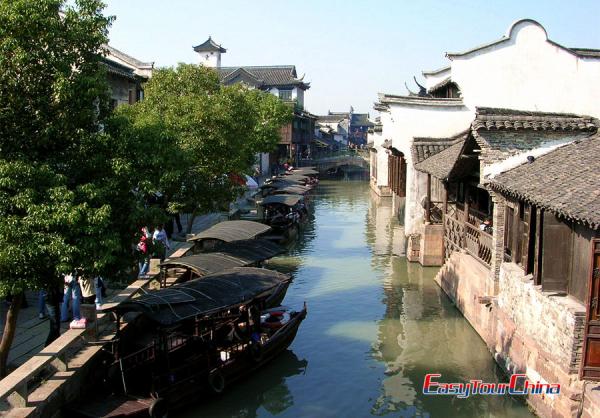
With a history of more than 7000 years, Wuzhen Water Town gathers all the unique features of downstream area of Yangtze River water towns. Over more than 1,000 years, Wuzhen has never changed its name, address, water system or lifestyle. Yet, the traditional buildings are still well preserved after crossing so many rough years. Within the town, with a dense network of rivers and wharves, people build their houses along the river and establish markets close to bridges.
Today, the Wuzhen Town is divided into four zones by a cross-shaped river, with the Beijing-Hangzhou Grand Canal running across the town, making it the only ancient water town adjacent to the canal. Also called “Oriental Venice”, Wuzhen Water Town has become a disseminator of traditional culture and an emissary of the communication between China and foreign countries because of its profound history and culture, graceful water town scenery, unique-flavored delicious foods, various and colorful folk-customs and festivals. In 1991, Wuzhen was ranked first among the six ancient towns south of the Yangtze River because of its rich cultural and long history background. No wonder it is a must-visit sight when you travel in Hangzou.
China Wuzhen Town Facts
Brief History of Wuzhen Town
Wuzhen Town, originally named Wudun. Archaeological research at the ancient cultural site of Tanjiawan near Wuzhen Town indicates that approximately 7,000 years ago, during the Neolithic Majiabang Culture period, the ancestors of Wuzhen cultivated rice, raised livestock, and wove hemp cloth while thriving in this area. This means that the land of Wuzhen stands as one of the earliest cradles of China's civilization.
During the Spring and Autumn Period, Wuzhen lay on the border between the states of Wu and Yue, with the State of Wu stationing troops here to guard against the State of Yue. In the Qin and Han dynasties, Wuzhen was administered either by Huzhou or Jiaxing in Zhejiang Province, or by Suzhou in Jiangsu Province.
By the Song Dynasty, Wuzhen entered its first golden age in history. Why? Because of its thriving water transport and burgeoning commerce. Situated on the Hangjiahu Plain, crisscrossed by a dense network of rivers, Wuzhen became a vital hub for the flow of goods between north and south. Silk, tea, grain, and porcelain all converged and dispersed here. Taverns, teahouses, inns, and pawnshops lined the streets one after another.
During the Ming and Qing dynasties, Wuzhen's economy and culture reached their zenith. Its silk industry flourished exceptionally, with every household engaged in sericulture, silk reeling, and weaving, earning it the title “Silk Capital.” Numerous wealthy merchants emerged, constructing grand mansions and courtyards. Landmarks in Wuzhen like Mao Dun's Former Residence, Zhaoming Academy, and Xiuzen Temple all date back to this era.
Wuzhen Attractions: What to See
Stone railings and arch bridges, arched gates across the street, imposing dwellings and spacious courtyards, river banks and verandas are all well preserved, presenting an original ecological scene of a water town in the South of Yangtze River. Within Wuzhen Town, there are now more than 40 hectares of late 19th century original buildings, and more than 100 ancient stone bridges of different shapes. It is just like a natural museum of ancient Chinese architecture.
The traditional workshops district, the traditional local-styled dwelling houses district, the traditional culture district, the local authentic Chinese food and beverage district, the traditional shops and stores district, and the water township customs and life district are six districts of Wuzhen.
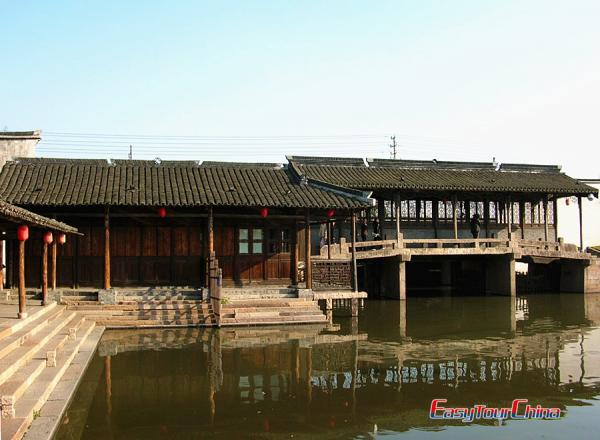
Dongzha (East Gate) Scenic Area
Dongzha showcases a rich water town culture and rustic folk house charm. Many locals still live in the houses lining the riverbanks. The scenic area includes attractions such as the former residence of Mao Dun, Xiuzhen Temple, and the Mu Xin Memorial Hall.
Folk performances include Fist Boat (10:30-10:40, 14:30-14:40) and Pole Boat (a third-batch National Intangible Cultural Heritage), with afternoon sessions at 13:00, 14:00, 15:00, and 16:00 (each lasting 20 minutes).
Hongyuantai Dyeing Workshop showcases traditional cloth dyeing techniques passed down since the Song Dynasty.
The scenic area offers guided tours and hand-rowed boats, with some local Wuzhen homestays providing lodging.
West Gate Scenic Area
Located at No. 18 Shifo South Road, West Street, Wuzhen, adjacent to the Beijing-Hangzhou Grand Canal, Wuzhen West Scenic Zone enjoys convenient transportation with direct road access to Suzhou and Tongxiang City in Jiangsu Province. Unlike East Gate, which focuses on original local life, West Gate is primarily for business travel and leisure vacations.
Covering an area of 4.92 square kilometers, it boasts over 9,000 meters of waterways and 72 ancient bridges connecting 12 small islands, making it the ancient town with the highest density of waterways and the largest number of stone bridges in China.
It features 250,000 square meters of Ming and Qing dynasty architecture, with Xizha Old Street stretching 1.8 kilometers. Riverside pavilions line both banks for 1.8 kilometers. The northern area encompasses over 50,000 square meters of natural wetlands.
Xizha regularly hosts the Wuzhen Theatre Festival, featuring seven indoor theaters and a water stage. Traditional experiences like open-air movies and Pingtan performances are offered, with special events during festivals like the Double Seventh Festival.
Jiangnan Hundred Beds Museum
China's first museum dedicated to collecting and exhibiting antique Jiangnan beds, located at No. 210 East Street in Wuzhen (also known as Zhaojia Hall). Spanning approximately 1,200 square meters, it displays dozens of exquisite antique Jiangnan beds from the Ming, Qing, and modern eras.
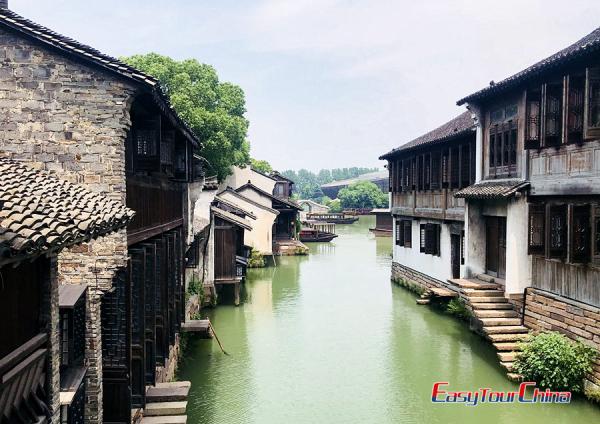
Jiangsu-Zhejiang Subprefecture
Known as the Zhejiang-Zhili Subprefecture during the Ming Dynasty, this unique government institution in Wuzhen's history oversaw salt patrols, crime suppression, and local litigation, commonly called the “Second Prefecture Office.” Established during the Jiajing reign of the Ming Dynasty and abolished in the early Republic era, it underwent multiple reforms and relocations over its 370-year history.
Jiangnan Folk Customs Hall
This hall showcases folk customs from the late Qing Dynasty to the Republican era in Wuzhen, including longevity celebrations, marriage and childbirth rituals, and seasonal observances. Wax figures depict traditional wedding ceremonies. The Attire Hall uses artifacts, wax figures, and photographs to display clothing customs from over a century ago in Jiangnan.
The Festival Customs Hall showcases the distinct seasonal practices of Wuzhen residents throughout the year, including: New Year's greetings during Spring Festival, Lantern Festival bridge-walking, Qingming Festival incense market, Weighing people at the start of summer, Eating zongzi during Dragon Boat Festival, Sun-drying insects on Tiankuang Festival, Mid-Autumn Festival moon viewing, Climbing heights on Double Ninth Festival, and Ancestor worship at Winter Solstice.
Jiangnan Wood Carving Gallery
Originally the Xu Family Residence in Dongzha, also known as the Hundred Flowers Hall, this site is renowned for its exquisite wood carvings. The main hall and side rooms display masterpieces of ancient Chinese wood carving, depicting folk customs characteristic of the Jiangnan region.
Yu Liuliang Coin Museum
Yu Liuliang, a native of Wuzhen and renowned numismatist, authored over ten scholarly works including Chinese Flower Coins and Chinese Appraisal and Collecting. His four-decade collection spans over 26,000 historical coins from more than 230 countries and regions worldwide, dating from the Xia and Shang dynasties to modern times.
>> Related reading: 10 Best Museums in China
Wenchang Pavilion
A pavilion named Wenchang Pavilion stands on the riverside wharf before Lizhi Academy. A narrow street, Guanqian Street, separates the academy from the pavilion. In bygone days, scholars visiting Wenchang Pavilion typically arrived by small boat, accompanied by servants.
Xiuzen Temple
Located in the central market area of Wuzhen Town. In the first year of the Xianping era of the Northern Song Dynasty (998 AD), Taoist Zhang Dongming built a hut here, cultivated his spiritual practice, attained enlightenment, and founded “Xiuzen Temple.” It is counted among the Three Great Taoist Temples of Jiangnan, alongside Suzhou's Xuanyao Temple and Puyuan's Xiangyun Temple.
Ancient Theater Stage
The theater stage of Xiuzen Temple is an auxiliary structure of the temple. Originally built in the 14th year of the Qianlong reign of the Qing Dynasty (1749), it suffered repeated damage like the temple itself. The existing structure was restored in 1919. A small staircase at the rear ground floor leads to the upper platform, while a trapdoor beneath the riverside pier provides access to boats. The platform comprises two sections: the rear houses dressing rooms, while the front stage faces the square.
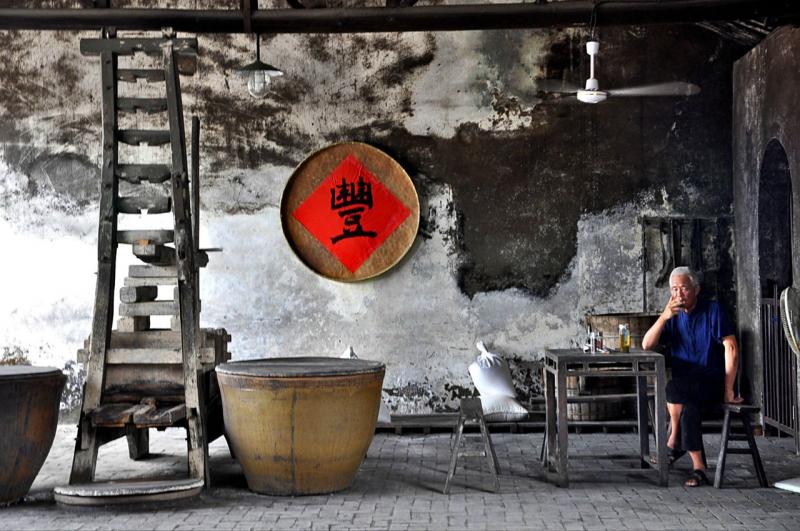
Huiyuan Pawnshop
Located between Yingjia Bridge and South Flower Bridge, this two-story building features a five-bay frontage with a 1.8-meter-high counter. According to the Wuzhen Town Annals, the town once hosted up to 13 pawnshops. By 1931, only Huiyuan Pawnshop remained in operation.
Mu Xin Art Museum
Constructed over four years, the museum is curated by Chen Danqing, a student of renowned Chinese painter Mu Xin. It displays Mu Xin's paintings and manuscripts from various periods.
>> Recommended Hangzhou tours to Wuzhen:
Top Things to Do in Wuzhen, Zhejiang
Is Wwuzhen worth visiting? Of course, in addition to taking a stroll though the town, here are more ideas for what to do in Wuzhen.
Wuzhen Theatre Festival
The Wuzhen Theatre Festival was jointly initiated by Chinese theatre masters and cultural figures Chen Xianghong, Huang Lei, Sam Lai, and Meng Jinghui. Centered around four core components—Invited Productions, Young Artists Competition, Ancient Town Carnival, and Town Dialogues (including forums and workshops)—the festival leverages Wuzhen's water town scenery and diverse theater complexes to host theatrical events. Primary venues include the Wuzhen Grand Theatre and five classical small theaters.
The Ancient Town Carnival features over 2,000 street performances spanning traditional crafts, avant-garde theater, multimedia installations, and other art forms.
Riding a Gondola
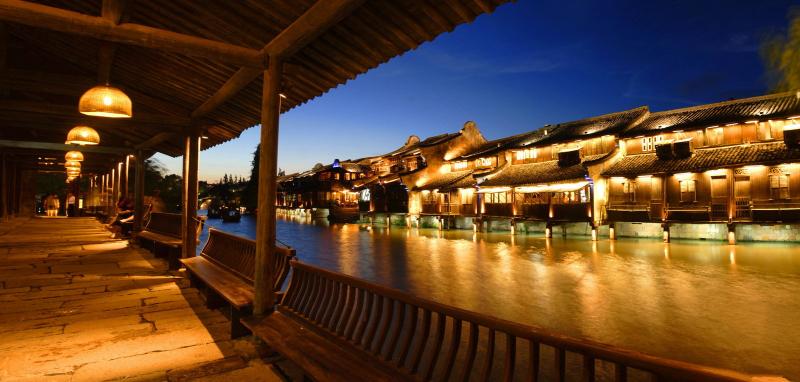
Riding a gondola is the best way to explore Wuzhen water town. We especially recommend a nighttime gondola ride to see lanterns illuminating both banks, their reflections dancing on the water. Additionally, the daytime floating market (open 7:00-9:00 AM) lets you experience the locals' “morning tea” lifestyle.
Savoring Wuzhen's Local Cuisine
Suggested Wuzhen Itinerary in One Day
Wuzhen Weather and Best Time to Visit
Wuzhen Water Town is located in the southeast coastal area and has a typical subtropical monsoon climate. It is warm and humid, with abundant rainfall, sufficient sunlight. The annual average sunshine duration is 1842.3 hours. It features a long spring and short autumn, cold winter and hot summer, warm spring and cool autumn, with distinct four seasons. Spring lasts 78 days, summer 90 days, autumn 64 days, and winter a full 133 days.
The annual average temperature is 16.1°C. January is the coldest month with an average temperature of 3.6°C, while July is the hottest at 28.1°C. The annual average precipitation is 1233.9 millimeters. There are three distinct precipitation periods throughout the year: April to May (spring rain), June to July (plum rain), and August to September (autumn rain). Snowfall may occur during winter.
Spring (March to May) and autumn (Septembe to November) are the best seasons to visit Wuzhen.
>> Keep reading: Explore Wuzhen Water Village with Photos
Hotels in Wuzhen Town
Looking for accommodation in Wuzhen? You can stay in luxury hotels, themed boutique hotels, and guesthouses either inside or around the Xizha scenic area. Recommended hotels include: Crowne Plaza Wuzhen, Alila Wuzhen, Ockside Boutique Hotel Wuzhen, Splendid Clubhouse Wuzhen, Tong An Hotel Wuzhen, and Waterside Resort Wuzhen.
How to Get to Wuzhen Water Village
From Tongxiang to Wuzhen
- Tongxiang High-Speed Rail Station to Wuzhen Bus Station: Take K282/K281.
- Tongxiang High-Speed Rail Station to Wuzhen West Gate Scenic Area: Take Night Bus 009/Night Bus 006.
- Tongxiang Bus Terminal to Wuzhen Bus Station: Take K231
From Shanghai to Wuzhen
- Shanghai South Station to Wuzhen Bus Station: 4 buses daily from 8:55 to 16:05.
- Shanghai South Station to Wuzhen West Gate Scenic Area: 7 buses daily from 8:10 to 17:20.
- Shanghai Hongqiao West Long-Distance Station (Hongqiao Long-Distance Bus Terminal) to Wuzhen Xizha Scenic Area: 4 buses daily from 8:50 to 17:50.
From Hangzhou to Wuzhen
- Hangzhou Changyun Wulinmen Station (via Hangzhou East Railway Station Bus Terminal) to Wuzhen Xizha Scenic Area: 13 buses daily.
- Xiaoshan Airport to Wuzhen West Gate Scenic Area: 4 buses total.
From Suzhou to Wuzhen
Suzhou Tourism Hub to Wuzhen West Gate Scenic Area: 8 buses total.
From Xitang Water Town to Wuzhen
G3 Route: Wuzhen West Gate Scenic Area — Puyuan Fashion Ancient Town — Xitang
Plan a Wuzhen Tour with Easy Tour China
With a long history and rich culture, Wuzhen Ancient Town offers so much to see and explore. Easy Tour China, one of the top China travel agencies offer China tours including Wuzhen, and a day trip from Hangzhou to Wuzhen. See recommended tours:
More Attractions in Hangzhou