The Grand Canal of China
Table of Contents
- 1. What is the Grand Canal in China?
- 2. China Grand Canal History
- 3. Major Cities on the Grand Canal, China
- 4. Top Heritages of The Grand Canal of China
China's only waterway running from north to south is 3200-km-long the Grand Canal of China (including Beijing-Hangzhou Canal). It is 10 times the length of Suez Canal (172.5 km in length, built in 1869) and 20 times that of the Panama Canal (81.3 km in length, built in 1914). Although the Grand Canal is not so imposing and famous as the Great Wall of China, it also embodies the superb wisdom of the Chinese people.
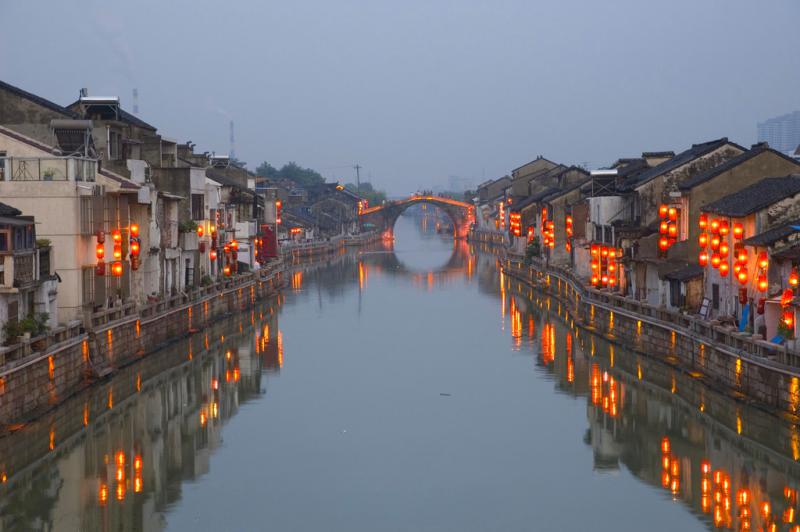
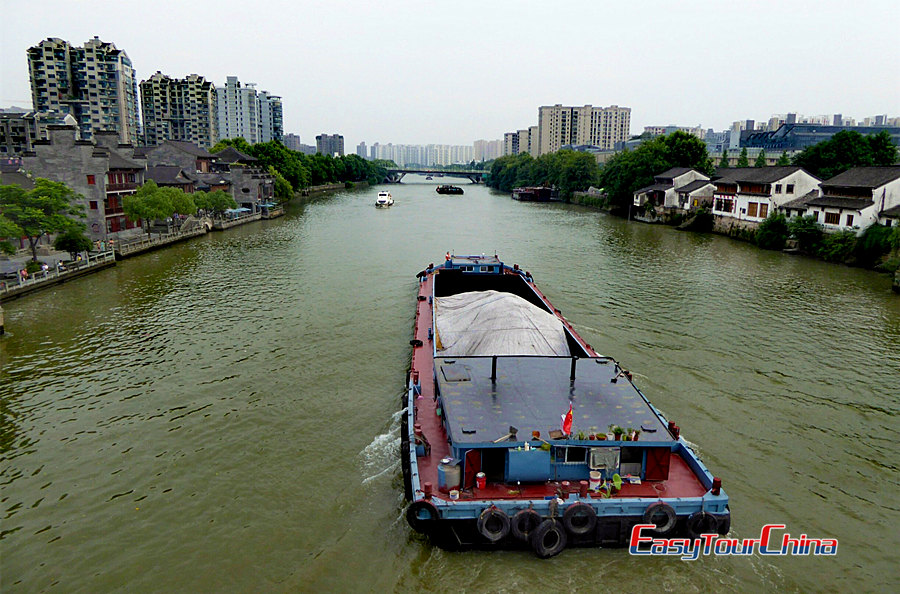
Joinning five rivers - Hai River, the Yellow River, Huai River, Yangtze River and Qiantang River, the Grand Canal in China has long been served as a means of transportation. The section of the Canal in Jiangsu and Zhejiang provinces are still full of vitality. Vendors paddle their boats directly to households, shops and storehouses in local townships.
Constructed around 605 to 610 in the Sui Dynasty, the Grand Canal China is the longest man-made water channel in the world. Beginning in Beijing, it runs through the Tianjin Municipality, Hebei Province, Shandong, Henan, Anhui, Jiangsu and Zhejiang province, the Canal has been one of the most important transportation artery linking North and South China.
On June 22, 2014, the Grand Canal of China was officially included in the World Heritage List as a cultural heritage. A cruise on the Grand Canal is one of the top things to do for a Hangzhou travel.
Quick Facts about the Grand Canal in China
What is the Grand Canal in China?
Where is the Grand Canal in China? And how long is the Grand Canal in China? Here comes the definition of this great ancient man-made structure.The Grand Canal is an ancient Chinese water conservancy project, consisting of the Beijing-Hangzhou Grand Canal, the Zhejiang-East Grand Canal and the Sui-Tang Grand Canal. With a Grand Canal of China map, you can see it is 3,200 kilometers long and spans across 8 provinces and municipalities including Beijing, Tianjin, Hebei, Shandong, Henan, Anhui, Jiangsu and Zhejiang. It passes through 35 cities. It runs through the North China Plain and connects the Haihe River, the Yellow River, the Huai River, the Yangtze River and the Qiantang River. It was the main artery for transportation between the north and the south in ancient China.
The entire canal is divided into seven sections: Tonghui River, North Canal, South Canal, Lu Canal, Middle Canal, Li Canal (formerly known as "Han River") and "Jiangnan Canal". It has been an important transportation route for grain transportation since ancient times and played a significant role in economic and cultural exchanges between the north and the south. After the mid-Qing Dynasty, due to the rise of maritime transportation in the north and the opening of the Tianpu Railway, its role gradually weakened.
China Grand Canal History
When Was the Grand Canal in China Built?
The Grand Canal of China is the world's earliest, largest, longest, and longest-used masterpiece of human water conservancy and waterway engineering. Its construction began in the Spring and Autumn Period, and the main project went through three stages: the Spring and Autumn and Warring States Periods, the Sui and Tang Dynasties, and the Yuan, Ming, and Qing Dynasties.
Who built the Grand Canal in China? And Why Was It Constructed?
- During the Spring and Autumn period, King Fuchai of Wu excavated the Han Gou Canal, forming the earliest segment of the Grand Canal's present-day waterway.
- Qin Shi Huang constructed the Ling Canal between Hunan and Guangxi.
- In the Eastern Han Dynasty, Cao Cao excavated the Bai Gou and Ping Lu canals.
- After Cao Pi replaced the Han dynasty, his minister Jia Kui excavated the Jia Hou Canal, while Deng Ai built the Guang Cao Canal.
- Emperor Yang of Sui Dynasty successively excavated the Tongji Canal and Yongji Canal, rebuilt the Jiangnan Canal, and dredged the Zhedong waterway, forming the Sui-Tang Grand Canal system.
- During the Yuan Dynasty, Kublai Khan organized the development of waterways like the Huitong River and Tonghui River, which later gradually formed the basic layout of the Yuan-Ming-Qing Grand Canal connecting north and south.
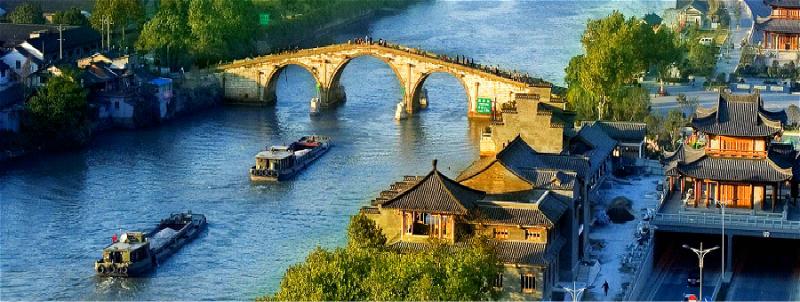
From the Spring and Autumn period to the Three Kingdoms era, regional canals like the Hangu Canal, Lingqu Canal, and Zhengguo Canal were excavated to address transportation, irrigation, and flood control needs, continually expanding the space for survival and development. During the Sui Dynasty, the Grand Canal immediately produced significant and far-reaching impacts politically, economically, and culturally.
The Tang Dynasty relied on the Grand Canal to transport grain from the southeast to the capital. Before the An Lushan Rebellion, the Grand Canal was the only waterway for grain transport. "The Yuan capital was in Yan (Beijing), extremely far from Jiangnan (southern China), yet the numerous government offices, guards, and commoners all depended on Jiangnan for supplies." In 1293, the Grand Canal, connecting Jiangnan and Dadu (Beijing), was completed, and "the transport of grain and the boats of merchants from the south all traveled from Zhigu to Tonghui River."
During the Ming Dynasty and the mid-Qing Dynasty, the Grand Canal, leveraging its role as a waterway for grain transport, was repeatedly dredged and became a major transportation artery connecting the Haihe, Yellow River, Huaihe, Yangtze River, and Qiantang River systems.
How Did the Grand Canal Help China's Economy and Cultural Exchange?
- The Grand Canal transformed the natural ecosystems of the regions along its course, solved irrigation and flood control problems, and maximized the efficiency of the unified use of people, resources, and capital, thus contributing to improved livelihoods and boosting the economic and social development of the areas along its banks.
- The Grand Canal's completion overcame geographical limitations on the exchange of diverse cultures, effectively promoting communication and integration between different regions and ethnic groups in the north and south. The Grand Canal also served as a channel for ancient East-West cultural exchange. In the history of world cultural exchange, renowned travelers from home and abroad, such as Jianzhen, Marco Polo, Odoric, and Matteo Ricci, all left their mark on the Grand Canal's flowing waters.
- The Grand Canal was intrinsically linked to ancient China's economic development. It served as the primary artery for transportation and economic exchange between northern and southern China. Additionally, it functioned as a commercial route, acting as the golden waterway for trade between ancient China and other nations.
- In ancient times, the Silk Road overland and the Maritime Silk Road operated as relatively independent transportation systems. The completion of the Grand Canal connected these two routes, providing a vital passage for the movement of people and goods.
Today, all sections of China's Grand Canal are navigable except for the segments between Beijing and Tianjin, and between Linqing and the Yellow River. Upon completion of the planned East Route of the South-to-North Water Diversion Project, the Grand Canal will serve as a vital water conveyance route.
Major Cities on the Grand Canal, China
Political and Grain Transport Hubs
Beijing
Capital of the Yuan, Ming, and Qing dynasties. The Grand Canal annually delivered millions of shi of grain to Beijing, along with timber and other materials for palace construction. The Tonghui River's old course and Shichahai Lake still echo with tales of the canal's former prosperity.
Canal Heritage: Tongzhou Canal Park, Randel Tower, Yuhe Ruins.
>> Recommended Beijing tours:
Huai'an
Hailed as the “Capital of the Grand Canal,” Huai'an served as the seat of the Grand Canal Transport Commissioner during the Ming and Qing dynasties, overseeing grain transportation nationwide. Situated at the confluence of the Yellow River, Huai River, Sishui River, and the Grand Canal, it became the pivotal hub of the canal transport network. The unique “ships south, horses north” phenomenon originated here, where vessels from the south switched to land transport via carts and horses for the journey northward.
Canal Heritage: Qingjiang Weir, Remains of the Grand Canal Transport Commissioner's Office, Hexia Ancient Town.
Jining
Throughout the Yuan, Ming, and Qing dynasties, Jining housed the highest administrative body for canal management: the Grand Canal Commissioner's Office. Strategically positioned at the highest elevation “water ridge” section of the canal, its critical hydraulic engineering transformed Jining from the “Hometown of Confucius and Mencius” into a pivotal regulator of the nation's north-south lifeline.
Canal Heritage: Site of the Grand Canal Commissioner's Office, Nanwang Water Diversion Hub Engineering Site, and Huitong River-related sites.
The Most Important Cities
Yangzhou
China's sole “Canal City” that grew alongside the Grand Canal. With the Grand Canal's opening, Yangzhou became one of China's foremost water and land transportation hubs, serving as a distribution center for goods like salt and tea. As the seat of the Two Huai Salt Transport Commissioner, Yangzhou also flourished as a national financial center, earning the reputation of “Yangzhou's wealth surpassing all under heaven.”
Canal Heritage: Salt merchant gardens like Geyuan and Heyuan, ancient canal waterways, and the Sanwan Scenic Area.
Suzhou
The Xujiang River, excavated by Wu Zixu—founder of Suzhou—stands among the world's earliest man-made waterways. The Grand Canal shaped Suzhou's dual grid layout of “parallel waterways and adjacent streets” and its elegant urban character. Thriving agriculture, textiles, and handicrafts transformed it into a paradise where merchants from all corners converged.
Canal Heritage: Historic districts like Shantang Street and Pingjiang Road developed along the canal, preserving the dual grid pattern of “parallel waterways and adjacent streets” to this day.
>> Recommended 3 Days Suzhou Tour with Grand Canal
Hangzhou
The southern terminus of the Grand Canal. During the Tang Dynasty, leveraging the canal's access to rivers and seas, Hangzhou stood alongside Guangzhou and Yangzhou as one of China's three major trading ports. During the Southern Song Dynasty, with the help of the well-developed canal transportation system, the population of Hangzhou soared and it ranked among the top ten cities in the world.
Canal heritage: Qiaoxi Historical District, Gongchen Bridge, Xiahezhiji Street, and the China Beijing-Hangzhou Grand Canal Museum.
>> Recommended 3 Days Essential Hangzhou with Wuzhen & Grand Canal Heritage Tour
Tianjin
As a transportation hub for both river and sea transport, Tianjin saw its status as a gateway to the capital rise dramatically thanks to the reopening of the Grand Canal and the development of maritime trade during the Yuan Dynasty.
Canal Heritage: Sanchahekou (the confluence of the Grand Canal and the Haihe River, known as the birthplace of Tianjin), Ancient Culture Street.
>> Recommended 3 Days Tianjin Highlights Tour
Top Heritages of The Grand Canal of China
Historical District of Qiaoxi Direct Street in Hangzhou
Address: 50 meters northeast of the intersection of Xiahe Road and Qiaolong Street in Gongshu District, Hangzhou
This is one of the important historical and cultural districts in Hangzhou. It is named after an ancient bridge in Hangzhou - Hangzhou Bridge. This historical district preserves a rich collection of ancient buildings, cultural landscapes and traditional styles, showcasing Hangzhou's long history and unique cultural charm.
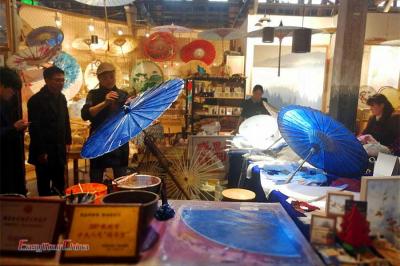
In addition, you can witness the traditional handicraft production process, such as embroidery, paper-cutting, pottery, etc., and also taste the authentic Hangzhou food.
Hangzhou Grand Canal Museum
Address: No. 1, Canal Culture Square, No. 34 Jinhua Road, Gongshu District, Hangzhou, Zhejiang Province
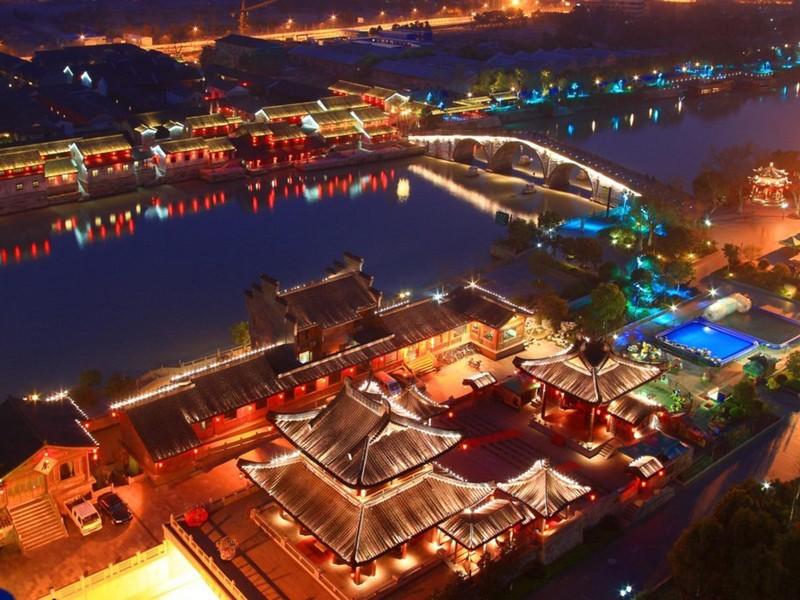
A museum dedicated to showcasing and researching the history and culture of the Grand Canal. It displays a large number of historical artifacts, pictures, physical models, and other exhibits related to the Grand Canal, introducing the origin, development, and significant impact of the canal on China's transportation, economy, and culture.
>> Related reading: 10 Best Museums in China
Qingming Bridge Historical and Cultural District, Wuxi
Address: Qingming Bridge Ancient Canal Scenic Area, Nan Chang District, Wuxi City
The Qingming Bridge was built in the Ming Dynasty and is a stone arch bridge that spans the Wuxi Canal. It is renowned for its unique architectural style and exquisite carvings. The Qingming Bridge Historical and Cultural District is centered around this ancient bridge, and along the riverbank, many traditional buildings, courtyards, and shops have been preserved.
Taierzhuang Ancient City, Zaozhuang, Shandong Province
Address: Taierzhuang District, Zaozhuang City, Shandong Province
Built in the early Ming Dynasty, it was once a famous battlefield and military fortress. The city retains many buildings from the Ming and Qing Dynasties, including city walls, city gates, government offices, temples, and residences.
Taierzhuang is known by the World Tourism Organization as a "living ancient canal" and is "the only remaining heritage village along the Grand Canal."
Shichahai, Beijing
Address: Opposite the North Gate of Beihai Park, Xicheng District, Beijing
Beijing's Shichahai, also known as Houhai, is the historic urban section of the Grand Canal. Comprising three interconnected lakes—Qianhai, Houhai, and Xihai—it stands as one of Beijing's oldest and most distinctive lakes.
FAQS
How did the Grand Canal Affect Song Dynasty of china?
The Grand Canal played an unprecedentedly crucial role in the Song Dynasty (960-1279) - reshaping the economic geography and business models of the Song era. On one hand, it achieved the "transportation of grain from the south to the north", solving the problem of food supply for the capital city Kaifeng and other major cities at that time. On the other hand, the low cost of water transportation greatly stimulated long-distance trade and the formation of a national market. Paper money (Jiaozi, Huizi) and credit institutions thus emerged. Moreover, the canal also promoted the specialization of handicrafts. As a result, a large number of merchants, artisans, and laborers appeared at that time.
What are the top cuisines to taste?
While learning about the history and culture of the Grand Canal, you can also savor related Chinese food such as Yangzhou fried rice, Peking duck, Wuxi braised fish, Caobang cuisine, lotus banquet on Weishan Lake, Shaobo braised fish, and many more.