Zhongyang Pedestrian Street (Harbin Central Street)
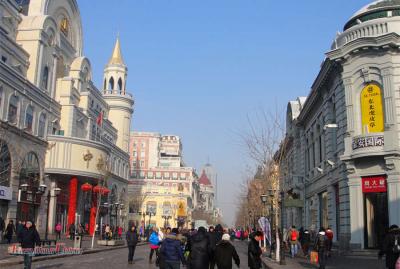
Being a rare architectural art corridor as well as one of the longest and biggest pedestrian streets in Asia otday, Zhongyang Pedestrian Street has been the most prosperous commercial hub in Harbin for over one hundred years, and also become a must-see site when you travel in Harbin.
Zhongyang Street was first built in 1898 and was originally called Chinese Street. Strongly featured by the western architecture, Harbin Zhongyang Pedestrian Street perhaps is the most typical tourist destination to understand the development history of North China. In May, 1924, Harbin Central Street was floored with square stones according to a Russian engineer's design. Since then it has become a rendezvous of numerous foreign shops, hotels, and bars.
The street has kept in good shape with a few repairs in the past, thanks to its good quality. It began to take shape as an international street in the 1920s. Russian leather, British woolen cloth, French perfume, German medicine and plenty more can be found in this fashionable street. In 1997, Harbin government appointed the street as a pedestrian street.
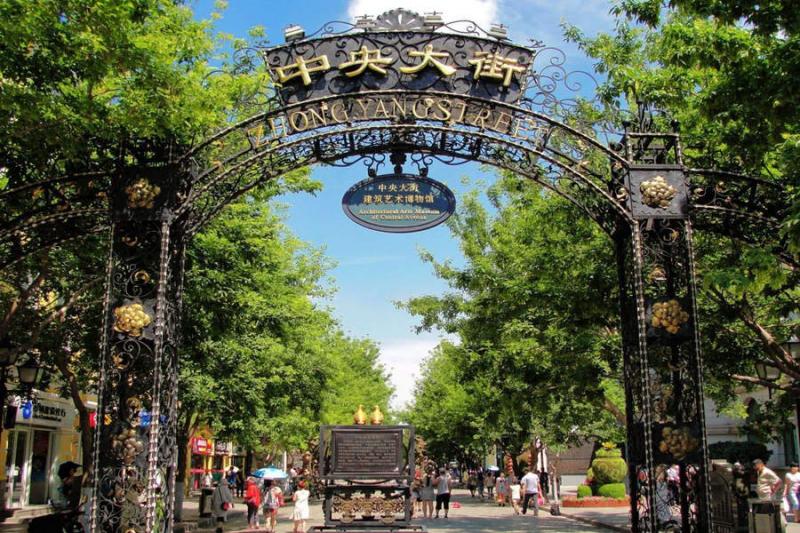
Zhongyang Pedestrian Street Facts
Brief History of Harbin Central Street
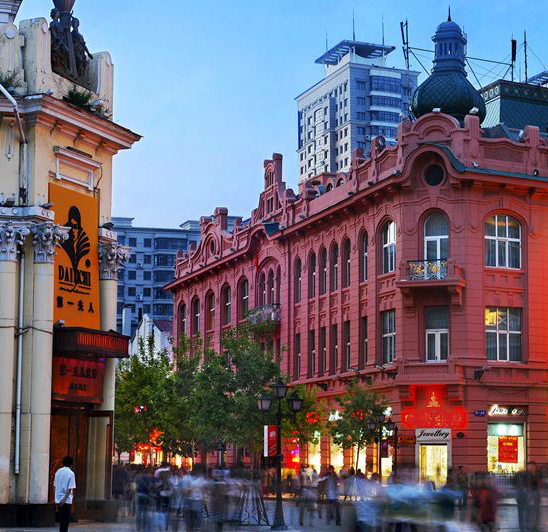
In the early 20th century, Russian refugees began flowing into the Harbin region due to the Russian October Revolution and the outbreak of national wars. Most of the European-style buildings along Central Avenue were constructed between the early 19th century and the 1930s. They blended two distinct cultures, transplanting architectural styles like Renaissance, Eclectic, and Baroque to Harbin. This re-created the architectural heritage formed across Europe during the 15th to 19th centuries—a span of four centuries—right on Central Avenue.
The direct catalyst for Central Avenue's development was the construction of the China-Eastern Railway, which introduced relatively advanced production methods and productivity. By the 1980s, with the rapid progress of reform and opening-up and the market economy, an increasing number of shops sprang up around Central Avenue.
Layout
Harbin Central Avenue stretches from the Songhua River Flood Control Memorial Tower in the north to Jingwei Street in the south, consisting of the main Central Street and 25 intersecting side streets. Its spatial design primarily relies on and connects local architectural heritage. The side streets on both sides extend from Shangzhi Street in the east to Tongjiang Street in the west, forming a rectangle that creates a pedestrian-friendly tourist commercial street with Central Avenue as its central axis.
What to See at Zhongyang Pedestrian Street
There are 71 buildings constructed in European style and 13 municipal protection buildings in Renaissance, Baroque, and Eclectic styles in this 1450 meter-long walking street.
There are many other exotic and appealing constructions there. All of them are well preserved and continuously play an important role in people's daily life. Zhongyang Pedestrian Street provides an enthralling destination which abounds with history, attracting tourists from home and abroad.
This long corridor of European architectural art is the pride of every Harbin.
>> Recommended Harbin Tours:
Major Zhongyang Pedestrian Street Attractions
Square-stone Road
The most distinctive feature of Central Street Harbin is that whole street was paved with square stones. In May 1924, the Central Street was floored with square stones according to a Russian engineer’s design. Each square stone that used for paving the road is 18cm long and 10cm wide. The shape and size of the stone are just like Russian bread, the surface is bright and round which is extremely rare in Chinese and overseas road history.
Former site of Matsuura
Located at No.120 of the Zhongyang Pedestrian Street, the former Matsuura Foreign Firm was built in 1906 and completed in 1909. The scope of business covers almost everything we need in daily life, such as clothing, food, cosmetics, metals, musical instruments, coals, etc. The former site of Matsuura Foreign Firm is the biggest form of Baroque architecture in Harbin and also the mark of the Central Street. Later, it was changed to foreign language bookstore after the liberation of New China.
Jewish Community Sites
Zhongyang Pedestrian Street was originally called “Chinese Street”, it was a central avenue in a cosmopolitan city with people from thousands of countries. More 70 European style buildings are gathered here to become an architectural art gallery. The Jews who good at doing business built many buildings in Central Street at that time, they are just like the witness of their life in Harbin. Walking from south to north from Zhongyang Pedestrian Street, you will see Miniature Restaurant, Jewish National Bank, Aokun Building, Modern Hotel, Rabinovich Building, Jewish Hospital, Jewish P. A. Berk Abramovich Building, The Main Synagogue, The Judaism School.
Flood Control Victory Monument
The Flood Control Victory Monument stands on the square along the Songhua River in the northern section of Central Street, Daoli District, Harbin, within the central area of Stalin Park. This structure commemorates the victory of Harbin's citizens over the catastrophic flood of 1957. The monument consists of a tower and a colonnade. The tower itself comprises a base, a shaft, and a crown, all crafted from granite and reaching a height of 22.5 meters. The base features two tiers of varying heights, symbolizing the water levels of the catastrophic floods in 1932 and 1957.
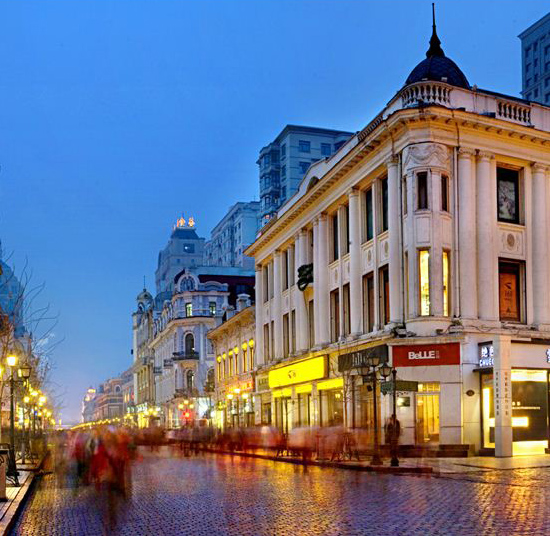
Former Site of Harbin First-Class Post Office
Constructed in the early 20th century, the former Harbin First-Class Post Office—originally named the Greizler Building—exhibits Art Nouveau style. It stands at the intersection of Central Avenue and Jingwei Street. In 1910, it served as the bank for the Far East Harbin Second Loan Company, and in 1914, it became Harbin's First-Class Post Office. That same year, it oversaw second- and third-class post offices across Heilongjiang Province and parts of Jilin Province. After China joined the Universal Postal Union, the Harbin First-Class Post Office was designated as an international mail exchange office.
As of February 2024, the former site of Harbin First-Class Post Office serves as a commercial complex housing travel agencies and other businesses.
Madier Hotel
Located on Central Avenue in Daoli District, Harbin, Madier Hotel is a designated “Historic Site of Preparatory Activities for the New Political Consultative Conference” in China. It exemplifies French Louis XIV classical architecture. With a total floor area of 9,000 square meters, it features guest rooms, a Western restaurant, a pavilion, a ballroom, and a cinema.
In 1953, the building was converted into the Harbin Hotel. Following extensive renovations in 1985, it reclaimed the “Madier” name in 1987.
Events on Central Street Harbin
The "Charming Harbin Summer" Old Street Music Festival was held at the intersection of Zhongyang Pedestrian Street and Friendship Road. Artists from the Harbin Symphony Orchestra and Harbin Opera House, organized by the Harbin Municipal Bureau of Culture, Radio, Film and Television, performed on stages at the intersection of Central Street and Friendship Road and on Xitoudao Street.
The Central Avenue String Concert, first held in 2016, featured a variety of performances including string quartets, saxophone solos, flute solos, clarinet solos, and violin solos.
Restaurants on Zhongyang Pedestrian Street Harbin
On Central Street of Harbin, you can savor authentic Chinese cuisine in the Northeast. This area is home to many time-honored restaurants, such as Lao Chu Jia, Shi Lou Yi Hao, and Lao Du Yi Chu.
"Shi Lou Yi Hao" is a collective name for 11 famous restaurants in Harbin's history, representing an era of Harbin's culinary scene.
Located on the third floor of "Shi Lou Yi Hao," the Harbin Cuisine History Museum is Harbin's first food culture museum. Through its authentic artifacts exhibition area, including tableware, recipes, and a recreation of restaurant street scenes from the past century, the museum offers a panoramic view of the historical culture of Harbin food industry, showcasing the fusion of Chinese and Western culinary traditions.
>> Recommended 7 Days Beijing Harbin Winter Tour
Best Time to Visit Zhongyang Pedestrian Street
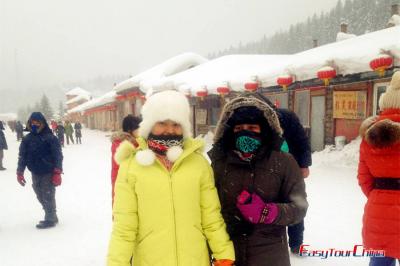
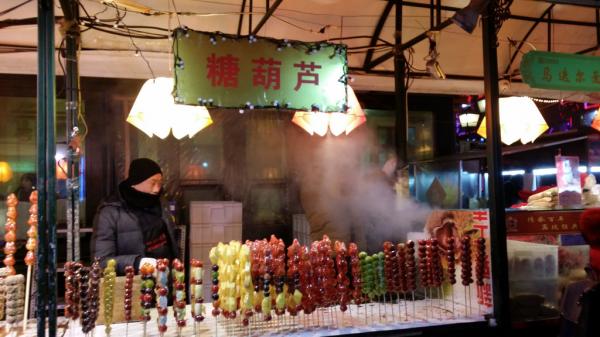
The best time for Harbin trip is from Dec to Feb of the following year. The snow and ice scenery at that time is very charming, with the Harbin Ice Festival to be held. People will display all kinds of ice sculptures, snow sculptures and other artworks on Central Avenue, which will not be removed until spring.
In addition, Harbin is located in the most northern part of China, and it is a metropolis with the highest latitude and lowest temperature in China. It is definitely one of the best places to visit in China in summer from Jul to Sep.
>> Know more about Harbin weather
How to Get to Zhongyang Pedestrian Street
1. It can be reached by bus 53, 113, 114, 126, get off at “Zhongyang Dajie” (Central Street) Station.
2. Take shuttle bus line 3 from Harbin Taiping International Airport, and get off at “Zhongyang Dajie” (Central Street) Station.
Where to stay: hotels on Harbin Central Street
You can choose the historic Modern Hotel (Madier Hotel), located in the heart of Central Street. Other highly recommended hotels include Holiday Inn City Centre Harbin, Shangri-La Harbin, Mercure Harbin Central Street Sophia Church, and Gfour Holiday Hotel.